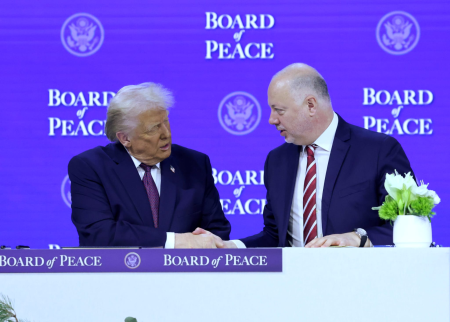



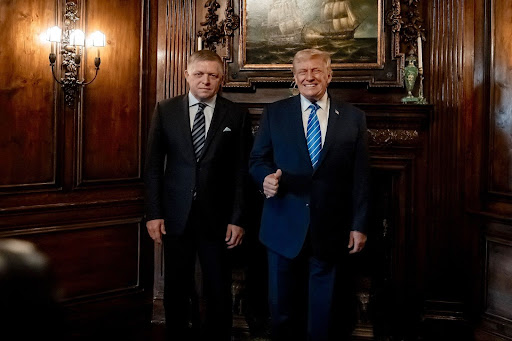
The meeting between the Slovak delegation and Donald Trump came after the United States set a goal in their national security strategy to strengthen “healthy nations” within the EU. According to experts, the White House is seeking allies there – not only in the cultural war, but also in efforts to weaken supranational institutions, including the EU, which it sees as “dysfunctional”.
“The EU is an institution in deep crisis,” two Western leaders agreed on Saturday evening (18 January). One of them was US President Donald Trump, who shortly beforehand announced the imposition of tariffs on EU member states that most strongly oppose his plan to seize Greenland. The other leader was one of the EU’s own representatives – Robert Fico.
He arrived in the US with a government delegation to sign an intergovernmental agreement on a civilian nuclear programme. Information about the subsequent talks with Donald Trump is available only from the Slovak prime minister’s perspective.
Fico presented the discussion at the presidential residence in Mar-a-Lago as a great honour and a sign of respect. According to him, they addressed several international issues, with particular attention to Russia’s war. “American representatives were interested in our positions because they knew we are not Brussels parrots and that we have long expressed our own sovereign views on the war in Ukraine,” he wrote on Facebook.
According to Fico, the talks also included a (contextually negative) assessment of the EU, its competitiveness, and its energy and migration policies. The prime minister did not mention condemning either the US attack on Venezuela or the aggressive rhetoric toward Greenland. At home, however, his government condemned both events.
The trip of the Slovak delegation to the US at a geopolitically sensitive moment, the rhetoric chosen during the visit, and the deepening of cooperation may indirectly point to a US objective declared as early as December.
Under its new National Security Strategy, the Trump administration’s priority is to strengthen so-called “healthy nations” in central, eastern, and southern parts of the EU. This is to be done through trade ties, arms sales, and cooperation at the political, cultural, and educational levels.
The relevance and immediacy of this strategy have been evident since the beginning of 2026. After the US clearly stated their aim to refocus on the Western Hemisphere, they abducted dictator Nicolás Maduro, effectively took over influence in Venezuela, and began issuing threats toward other countries in the region – from Latin America to Greenland.
Which European nations are “to Trump’s taste”?
An unpublished version of the strategy, published by Defense One, claimed these were Hungary, Italy, Poland, and Austria. US officials rejected the authenticity of the document. According to experts on the US consulted by EURACTIV Slovakia, “healthy nations” are those that meet the ideals of Trump’s Republicans.
According to a senior source in Slovak diplomacy who requested anonymity, these are essentially countries and regimes with which the US sees alignment on how society is governed and on issues it considers important. “These include national sovereignty, illegal migration, trade relations, and the ‘woke agenda’,” the source says.
Jan Hornát, head of the Department of North American Studies at the Faculty of Social Sciences of Charles University in Prague, expressed a similar view. In a recent interview with EURACTIV Slovakia, he said that Trump and his circle regard as “healthy” those states where they do not perceive the influence of what they see as “harmful liberalism”.
There is also a connection to the rhetoric of “healing”, which is part of the domestic US political debate, he adds. From the perspective of the Trump administration, today’s America is “healing” from all the problematic and “harmful policies” introduced by its liberal-democratic predecessors.
“According to Trump, all of these ideas are unhealthy, harmful, and lead to the weakening of America. Those European states where more traditional and conservative political forces currently govern or may govern in the future, are seen as countries willing to undergo this healing process,” Hornát says.
Allies in the cultural war
From this perspective, the US expert believes that today’s Slovakia is “rather on the side of the healthier” European countries. The states Trump would see as “sicker” are those in Western Europe governed by principles promoted by previous US administrations.
“From the American perspective,” Hornát explains, “at least the socio-cultural approach of Fico’s government is on what they see as the right side of the cultural conflict. In this respect, it closely resembles what Trump is trying to do domestically.”
The term “cultural conflict” is crucial here. In the US security strategy, Trump’s cabinet described Europe as a subject facing “civilizational decay”. According to analyst Dalibor Roháč of the American Enterprise Institute (AEI), the strategy showed that the US is willing to wage a cultural war against the EU and European democracies.
“And well, now they are looking for allies for it. From the perspective of broader American interests, this is, of course, madness,” he told EURACTIV Slovakia.
In the US, the cultural war is a powerful phenomenon. It pits a liberal-globalist camp against a (national-) conservative one. Hornát believes Trump wants to link this conflict to European realities. Strengthened conservative forces in Europe could then more effectively challenge the ideologically opposing camp that dominates in Brussels.
We have seen Republicans pursue this tactic repeatedly in recent years. Examples include open support for the far-right National Front in France, the AfD in Germany, as well as Fidesz in Hungary.
“Vance hates Europeans”
According to experts, the security strategy once again highlighted Trump’s aversion to supranational organisations, whether the UN or the EU, which he sees as undermining the sovereignty of nation states.
Some figures – such as Vice President J.D. Vance – do not even hide their antipathy toward Europeans. “Vance hates us,” Politico quoted a European diplomat as saying during talks on Greenland.
According to a diplomatic source cited by EURACTIV Slovakia, Trump’s preferred partner is an “uncomplicated nation state with a strong leader”. “Unfortunately, EU institutions have not generated or presented Trump – aside from sectoral exceptions – with a strong leader and partner who has clear, swift authority to carry out what is immediately agreed at the table,” the diplomat said.
In Trump’s world, the source added, there is no values-based alliance – only transactional ones. “Trump and those around him are interested in the EU only when it comes to trade negotiations and opening a market of more than 500 million consumers to American companies,” he adds.
Can Trump be interested in a Eurosceptic “V3”?
Is it therefore possible that Trump will increasingly bypass the EU and favour bilateral or regional alliances? According to Dalibor Roháč, this is already happening – for example through coalitions of the willing – and it is likely to intensify: “This does not necessarily have to be the result of American influence, but rather of the fact that the EU is not an ideal forum for making real-time security decisions.”
Experts are sceptical that this could ultimately lead to the emergence of a Trump-backed bloc in central and Eastern Europe.
“The US does not need a bloc of nations, but clear, strong leaders it can use to weaken institutions it considers dysfunctional – or, conversely, to advance those parts of its agenda it sees as priorities,” a diplomat says. “If, however, a group of geographically close countries with similar views on a specific issue emerges, it will not resist group-based solutions.”
In central Europe, the dynamics have shifted following the Czech elections. What has emerged is a “Eurosceptic Visegrad Three” that praises many of Trump’s policies. According to Roháč, a bloc bringing together Fico, Orbán, and Babiš may indeed form, but whether it would be unequivocally “pro-American” is another matter.
“Orbán himself has been a very unreliable ally even for Trump’s Washington. Moreover, for eastern European countries with a basic instinct for self-preservation, an alliance with pro-Russian forces – whether in Budapest or in Washington – is indigestible,” the analyst says.
In this context, he adds, it is also worth watching the reactions of Poland’s conservative Law and Justice party (PiS). “No matter how much they may share American cultural conservatism, Poland’s survival in the face of Russian aggression discourages a more enthusiastic response,” the expert concludes.