

When the United States topples the leader of another sovereign nation and frames it as a show of strength and a point of pride, the world takes notice. If America openly disregards international rules it helped to create, why should anyone else feel bound by them? This flawed logic has already become fodder for Russian propaganda and poses a broader challenge to the global order.
The Trump administration’s decision to carry out a direct military operation in Venezuela, capturing sitting President Nicolás Maduro along with his wife, is an event with implications far beyond Latin America. It is a symbolic moment – not merely because it removes another authoritarian leader, but because the country that has long served as architect and guardian of the post-World War II international order has now demonstrably undermined it.
When U.S. Attorney General Pam Bondi announced that Maduro would face prosecution in New York on charges related to drug trafficking and terrorism, Washington hailed it as “justice.” Yet in capitals around the world, many viewed it as a dangerous precedent. The operation demonstrates that unilateral military action, even when militarily effective, can erode the norms that govern global peace and security.
The policeman who turned criminal
Since 1945, the international system-anchored in the United Nations Charter, the inviolability of borders, and the prohibition of regime change by force—has been, to a large extent, an American creation. True, the U.S. has broken these rules before: Panama in 1989, multiple interventions across Central and South America, the Middle East. But the difference now is stark: never before has Washington acted so openly, without institutional justification, without a coalition, and without a trace of shame.
“This is a violation of international law and the UN Charter,” stresses Prof. Michał Fiedler of Adam Mickiewicz University. “The post-1945 system has now been brazenly undermined.”
The issue is not Venezuela alone. The real question echoing through diplomatic corridors worldwide is: where is the line? If a superpower can abduct the leader of another state, who – and on what grounds – will still feel compelled to uphold the rules?
A gift for the Kremlin
Moscow responded immediately. Russian Foreign Minister Sergey Lavrov accused the U.S. of a “blatant violation of international law” and of dismantling the very system it once built. Dmitry Medvedev, Vice Chairman of the Security Council, called the operation “lawless” – though his words carried an unmistakable note of grudging admiration.
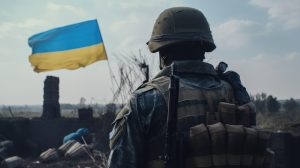
It’s a paradox that flips the world upside down: Russia, waging a brutal war of aggression against Ukraine, now casts itself as the defender of international order – and does so with striking propaganda effectiveness.
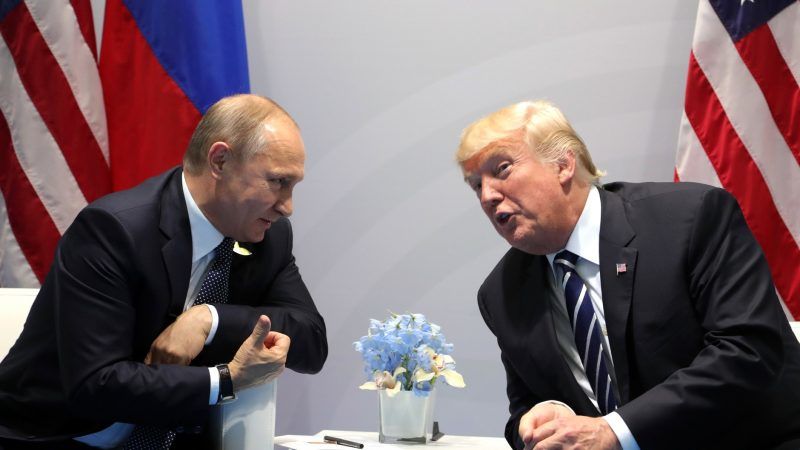
The Kremlin is already exploiting the “Venezuelan effect” to reinforce its narrative: if Donald Trump could forcibly remove Venezuela’s president, why shouldn’t Vladimir Putin change Ukraine’s leadership? If the U.S. can act outside the law, why should Russia bother?
The comparison is both false and dangerous – but it works.
False parallels
In both cases, international law was violated. But equating the U.S. operation in Venezuela with Russia’s aggression in Ukraine is misleading.
Russia’s attack has been ongoing since 2022, causing tens of thousands of civilian casualties, mass deportations, widespread destruction of cities and infrastructure, and bearing the hallmarks of genocide. By contrast, the U.S. operation was swift, limited in scope, and did not involve mass violence against civilians.
Russian disinformation deliberately blurs this distinction to deflect responsibility for its own crimes and undermine Western unity in support of Ukraine.
The U.S. decision also cannot be understood outside its domestic political context. Donald Trump needed a victory. His popularity is declining, the MAGA movement is fracturing, midterm elections are approaching, and tangible achievements under his administration are few.
Migration crises, chaotic trade policies, failed mediation attempts in Ukraine and the Middle East, and mounting scandals – from the Epstein case to internal administration conflicts – created pressure for a high-profile, decisive action. The brief operation in Venezuela and the capture of Maduro fit this scenario perfectly.
It is no coincidence that discussions about Greenland and threats toward Cuba and Colombia quickly followed. The “Venezuelan effect” reinforces Trump’s sense of power – just as the “Crimean effect” bolstered Putin in 2014.
What Trump achieved in Venezuela in days was Putin’s ambition for Ukraine: a rapid operation, a leadership change, and a display of force. Instead, Russia became mired in a war lasting nearly four years, resulting in political, military, and economic disaster.
Rather than enhancing its international standing, Russia faces isolation. Instead of stabilizing the regime, it has created an increasingly authoritarian dictatorship dependent on China. The sudden U.S. success only deepens the contrast and undermines the Kremlin’s credibility—both abroad and at home.
Poland in the shadow of a new chaos
For Poland, the stakes could not be higher. If the United States stops being the guarantor of the international order, a fundamental question arises: can it still be relied upon for security?
In the event of Russian aggression, will U.S. forces stationed in Poland respond? Is NATO’s Article 5 still an unshakable commitment – or just a political statement, dependent on Washington’s current interests?
U.S. violations of international norms reinforce the logic of power and encourage others to act similarly. Russia has long declared that the collapse of the Soviet Union was “the greatest tragedy of the 20th century,” and its goal remains the restoration of former spheres of influence.
Chaos on the international stage quickly spills over into domestic tensions. In Poland, voices are already questioning the value of adhering to the law, the constitution, and democratic procedures. On social media – especially X – comparisons of Prime Minister Donald Tusk to Nicolás Maduro are spreading, accompanied by calls for “intervention” or even “overthrowing the government.”
This mirrors exactly the disinformation playbook Russia has used against Ukraine: delegitimizing democratically elected authorities, undermining institutions, and normalizing political violence.
A world with no rules
The U.S. operation in Venezuela is not an isolated incident. It signals a world entering an era where the rule of force displaces the rule of law. For Russia, this is a gift – even if it temporarily loses influence in Latin America.
The question is no longer whether the international order is unraveling—it already has. Who will be next? And will Europe, particularly Poland, understand in time that in a world without rules, security is never guaranteed?