


A corruption scandal involving the EU diplomatic service has shaken the European Union. How can EU institutions restore their reputation and ensure that the Union remains a credible benchmark for candidate countries like Ukraine?
The procurement scandal that erupted in early December has undermined the credibility of EU institutions for three main reasons. First, it involved a key EU body, the European External Action Service (EEAS), with suspicions that a tender may have been rigged to favor a specific private entity.
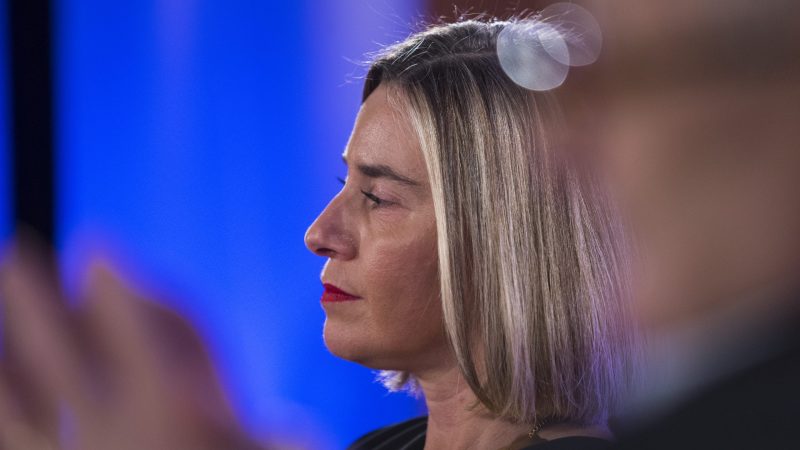
Second, one of the three accused is a former top EU official, Federica Mogherini, former EU High Representative for Foreign Affairs. Although the case concerns a period when she was no longer EU foreign minister but Rector of the College of Europe, her previous role remains relevant. As High Representative, she oversaw the EEAS. Investigators are examining whether she may have been aware of the alleged tender manipulation or used her contacts within the EEAS to secure a win for her institution.
Moreover, another accused, former EEAS Secretary-General Stefano Sannino, is not only a fellow Italian and colleague of Mogherini, but both hail from the same party – the center-left Italian Democratic Party (PD). This adds another layer to the suspicions.
As part of the investigation conducted by the European Public Prosecutor’s Office (EPPO), Mogherini, Sannino, and Cesare Zegretti from the College of Europe were arrested on the morning of December 2. Searches were carried out at their residences, EEAS headquarters, and the College’s Bruges campus. All three were released on bail that same night, as there was no risk of flight.
The EPPO has formally charged all three with corruption, conflict of interest, misappropriation of EU funds, and breach of professional secrecy. At the same time, the European Prosecutor’s Office stressed that, until Belgian courts prove otherwise, they are presumed innocent.
As often happens in such scandals, public attention intensifies when the allegations involve well-known figures, particularly those previously untainted by controversy. While Mogherini has faced criticism in the past – including for perceived softness toward Moscow and other regimes – her name has never before been linked to serious criminal allegations.
Yet another high-profile case
“Katargate” erupted at the end of 2022. Those involved included former MEPs and their associates, including former Vice-President of the European Parliament, the Greek Ewa Kaili. Allegations involved creating a group attempting to influence EU policies and resolutions on Qatar and Morocco in exchange for large sums of money. They were also accused of recruiting other MEPs.
On 9 December 2022, Belgian police carried out 20 raids at 19 different addresses across Brussels, arresting eight people in Belgium and Italy. The case has not yet been fully resolved.
The connection between “Katargate” and the latest scandal lies not only in the corrupt nature of the allegations but also in the fact that in both cases, most of the main accused are either Italians, members of the Party of European Socialists (or its group in the European Parliament), or both.
The second scandal leading to legal proceedings, “Pfizergate,” personally involved European Commission President Ursula von der Leyen and undisclosed SMS messages between her and Pfizer CEO Albert Bourla during vaccine contract negotiations for COVID–19.
The case reached the EU Court of Justice after complaints by the New York Times regarding the Commission’s refusal to release the messages. In May this year, the EU court ruled that the Commission “failed to provide a credible explanation justifying” its refusal to disclose the messages.
Further controversies involve former EU Commissioner for Justice and Rule of Law Didier Reynders, suspected of money laundering. He allegedly purchased lottery tickets through an organization he led as minister between 2007–2011, then transferred the laundered proceeds to his personal account.
Double Standards?
The Mogherini case “is not an isolated incident but further evidence of a systemic problem within the EU elites,” PiS MEP Bogdan Rzońca tells EURACTIV.pl. “For years, we’ve seen the same mechanism: a closed circle of power in Brussels, no real oversight, and scandals swept under the rug.”
“All of this undermines the credibility of institutions that present themselves as moral arbiters,” Rzońca adds.
He considers it “particularly striking” in the context of disciplining the PiS government on rule-of-law issues between 2015 and 2023, when Brussels “ruthlessly used the slogan of ‘rule of law’ as a tool of political pressure because Donald Tusk and the Civic Platform were not their political allies in Warsaw.”
“Today, it’s clear that double standards apply: sanctions and marginalization for member states resisting the left-wing agenda, and silence for their own elites,” Rzońca concludes.
Anna Bryłka from the Confederation shares a similar view. “The College of Europe is the EU’s premier training ground, meant to uphold the highest standards and guarantee quality for EU citizens. Mogherini is a politician who represented the EU on the world stage for five years,” she tells EURACTIV.pl.
Referring to the controversies around Didier Reynders, she also points to suspicions regarding his connections with Kremlin-linked oligarch Oleg Deripaska. “This man was the EU’s top official overseeing justice, while lecturing member states—including Poland—on the rule of law,” she stresses.
She notes that his home was only searched days after his term in the European Commission ended, and after von der Leyen had been approved for a new term as Commission President. “Surely a coincidence,” Bryłka adds sarcastically.
“I hope the media, public opinion, and opposition politicians will push for a thorough investigation of each of these cases. We cannot allow them to be swept under the rug due to crony networks at the top of EU institutions,” she concludes.
Corruption in the EU and Ukraine
Although no one has been officially proven guilty yet, critics of the EU mainstream have sparked a heated debate about corruption at the top of EU institutions. The discussion quickly referenced the latest corruption scandal within Ukrainian authorities.
The scandal broke on November 10, when the National Anti-Corruption Bureau of Ukraine (NABU) reported that during a 15-month operation called Midas, under the state company managing Ukrainian nuclear plants, Enerhoatom, at least $100 million had been embezzled.
According to NABU investigators, companies working with Enerhoatom were forced to pay hefty bribes—up to 10–15% of contract value. The money allegedly went to high-ranking state officials and businessmen close to President Volodymyr Zelensky, who were accused of collecting, sharing, and laundering the funds. Refusal to pay meant halted payments and removal from the supplier list.
Thousands of hours of recordings gathered by NABU reportedly implicate Timur Mindicz, owner of the TV studio Kvartal 95 founded by Zelensky, and his partner, businessman Ołeksandr Cukerman. Both left Ukraine before the scandal broke.
Right-wing groups accused Brussels of lacking credibility when lecturing Ukraine, given that it struggles with similar scandals internally.
Hungarian government spokesman Zoltan Kovacs wrote on X that “it’s ironic how Brussels lectures everyone on the ‘rule of law’ while its own institutions resemble a crime drama more than a functioning union.”
In another post about the same scandal, he claimed that the EEAS “acts as the de facto headquarters of the pro-war, pro-Ukraine EU political elite,” and its leadership “promoted the flawed view that the war requires unconditional, long-term financial and political support for Kyiv, as well as total isolation and vilification of Russia.”
Regarding Mogherini, he recalled that in 2019, as EU High Representative, she announced that Ukraine had received the largest support from the EU in its history during her tenure—€15 billion since 2014. Kovacs ignored, however, that Mogherini had previously faced criticism for policies seen as too lenient toward Russia, or even pro-Putin sympathies.
“Both in Brussels and Kyiv, the same pattern emerges: opaque procurement, internal networks, favored institutions, and money moving faster than oversight can keep up,” Kovacs concluded.
Even those who have themselves faced allegations or convictions have voiced opinions. Mariusz Kamiński, pardoned last year by Andrzej Duda and now a PiS MEP, said the EU “still refuses to declare war on corruption within its own ranks.”
“The Katargate scandal, the case around Reynders, the corruption threads surrounding Mogherini, and Russia’s corrupt-spy operations in the European Parliament and EU—none of these major scandals stirred the EU’s liberal-left establishment. Empty outrage matters more than cleaning up corruption in the EU,” he wrote on X.
EP Divided: “We Won’t Let This Be Silenced”
The dispute intensified over the alleged refusal to include the topic of EU corruption, in the context of the procurement scandal, on the agenda of December’s European Parliament plenary session. As reported by EURACTIV.pl, far-right groups Patriots for Europe and Europe of Sovereign Nations—both including MEPs from Konfederacja—had been pushing for such a debate.
According to sources within the EP, the majority supporting the current European Commission—Christian Democrats, Socialists, Liberals, and Greens—blocked the inclusion of an agenda item addressing the “urgent need to examine transparency and accountability in EU institutions.”
When asked whether Patriots for Europe would continue pressing for a debate in future EP sessions, Anna Bryłka responded affirmatively: “We will keep returning to the issue of corruption in EU institutions; we won’t let it be silenced,” she declared.
Similarly, Bogdan Rzońca from PiS, part of the European Conservatives and Reformists group, believes that a debate on corruption in EU structures “is urgently needed.” He added: “Postponing it under the pretext that it’s ‘too early’ is just another example of Brussels elites shielding themselves from political accountability.”
His party colleague, Jadwiga Wiśniewska, agrees: “Such a debate definitely needs to take place, because transparency in EU institutions should be a fundamental value,” she told EURACTIV.pl.
She acknowledged, however, that she is not surprised the “liberal-left majority wants to sweep the issue under the rug again.” According to her, this has been the same modus operandi for years.
“All discussions inconvenient for the establishment that selects the European Commission and effectively sets the tone in the EU are systematically silenced and trivialized. This has little to do with democracy, the rule of law, or transparency,” Wiśniewska emphasized.
Right-Wing Blind Spot?
A different view comes from Michał Kobosko, who believes there is no need to rush the debate. “We currently have no information that could form the basis for a substantive discussion in the EP,” he told EURACTIV.pl. According to him, the far-right is only seeking “another quarrel and an opportunity to attack the European project.”
Robert Biedroń, however, points out that the same right-wing groups pushing for a debate on corruption in EU institutions “are themselves under investigation for the embezzlement of over €4 million by their faction in the European Parliament.”
In July, the European Public Prosecutor’s Office (EPPO) opened a formal investigation into allegations of misuse of EU funds by the Identity and Democracy (ID) group, a now-defunct far-right faction in the European Parliament, which included Marine Le Pen’s French National Rally (RN).
Separately, earlier this year, a Paris court convicted Le Pen of misusing EU funds related to the fictitious employment of parliamentary assistants and imposed a five-year ban on her running in elections. Le Pen has appealed the ruling.
“I therefore call on everyone not to be misled by such cheap far-right tricks,” Biedroń said, adding that corruption “is a pathological phenomenon and must always and everywhere be fought, regardless of political color.”
He also rejects claims that his faction of Socialists and Democrats in the EP tried to cover up the case simply because it involved “their” people—both Mogherini and Sannino come from Italy’s Democratic Party, which belongs to the Party of European Socialists.
“The faction reacted properly, immediately calling on the relevant authorities to thoroughly investigate the case. I don’t see how anti-EU populists shouting slogans could help the investigation,” the left-wing MEP concluded.
The Battle Over the Future of EU Integration
EU institutions struggle with transparency, says political scientist Dr. Spasimir Domaradzki from the University of Warsaw in an interview with EURACTIV.pl. Regarding Mogherini and Sannino, “we are talking about a case that has come to light, but we cannot pretend that corruption scandals have not occurred in the European integration process,” he notes.
“Despite efforts to democratize European integration, its legitimacy remains largely secondary. We do have elections to the European Parliament, but the mechanism translating voters’ will into political decisions still leaves much to be desired,” the expert adds.
He emphasizes that such scandals provide fuel for parties critical of further European integration and the Union’s current political philosophy. “For them, it is proof—often misinterpreted—that EU institutions are susceptible to abuses stemming from positions of power and networks of dependency. That is why such cases must be publicized and consistently pursued to the end,” Domaradzki stresses.
On the other hand, according to the scholar, for the far-right, the mere existence of the integration process is a political “sin.” “Any incident that can be presented as proof of institutional pathology is exploited and blown out of proportion,” he says.
He argues that Europe is currently witnessing an ideological struggle over the future direction of integration. “Every vision—whether one that deepens integration or one that rejects it entirely—leverages both the successes and the missteps of the Union. Any example pointing to potential pathologies becomes an argument in this debate,” he notes.
Scandals like the latest corruption case easily become fodder for Eurosceptics, as they are simple to publicize and seamlessly fit into the narrative of the so-called “Brussels bureaucracy”—highly paid, privilege-seeking, and making decisions over the heads of politicians and societies, agrees Dr. Piotr Buras, director of the Warsaw office of the European Council on Foreign Relations (ECFR) and expert on European politics and Germany.
“Now there is an additional claim that this bureaucracy is completely corrupt. All of this fits perfectly into the story circulating in public debate almost everywhere today,” Buras points out in an interview with EURACTIV.pl. According to him, this has negative consequences for the EU regardless of the final outcomes of any investigations.
Strengthening Transparency: A Key Step
The only reasonable response to the exploitation of corruption scandals in the EU by Eurosceptic forces is full transparency in the proceedings—“both in terms of the investigation itself and in clearly explaining how the problem arose—and, of course, punishing the guilty if the allegations are confirmed,” emphasizes Buras.
“Similar cases occur in Ukraine, Poland, and other countries. The fact that corruption and abuse happen is, unfortunately, part of the reality in which modern societies operate. EU structures are not completely immune to this either,” he notes.
“We will not create a world free of scandals,” agrees Domaradzki. However, he adds that what is crucial for defending the integration process is something else: the effectiveness of detecting and combating such abuses and full transparency throughout the investigation process.
Buras shares this view but warns that “we should not be under any illusions that this will convince everyone.” “In today’s public debate, facts have limited reach. Even if everything is conducted according to procedure, false narratives, cynical interpretations, and fabricated claims will continue to circulate,” the expert stresses.
“Nevertheless, this is the only path EU institutions should follow: not to hide the problem, not to deny it, but to investigate the truth transparently and demonstrate the effectiveness of the bodies tasked with addressing such abuses,” he concludes.