


The European Union has reached a political agreement on a trade deal with India. But why is it sparking far less debate than the Mercosur deal? How do the two agreements differ?
The EU has concluded negotiations on a trade agreement with India, marking the largest deal of its kind ever struck by either side.
According to the European Commission, the agreement will strengthen economic and political ties between the world’s second- and fourth-largest economies at a time of rising geopolitical tensions and global economic challenges.
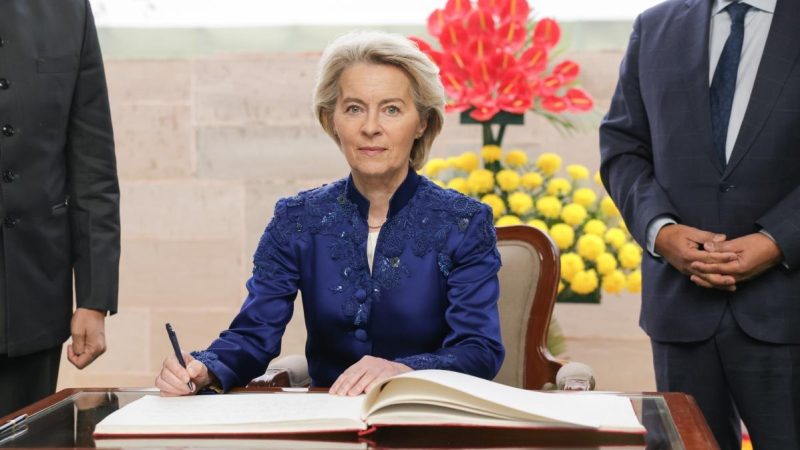
“We have created a free trade area covering 2 billion people, from which both sides will benefit economically. We have sent a signal to the world that rules-based cooperation still delivers excellent results. (…) We will build on this success and continue to deepen our relationship,” said European Commission President Ursula von der Leyen.
Currently, the EU and India trade goods and services worth over €180 billion annually, supporting nearly 800,000 jobs in the EU. Under the new agreement, EU goods exports to India are expected to double by 2032, thanks to the elimination or reduction of tariffs covering 96.6% of the value of EU exports to India. The Commission estimates this will save European producers around €4 billion a year in customs duties.
These are the largest trade preferences India has ever granted to a partner. The Commission notes that they will provide a significant competitive advantage to key EU industrial and agri-food sectors.
India is the world’s most populous country (1.45 billion people) and its fastest-growing major economy, with an annual GDP of €3.4 trillion.
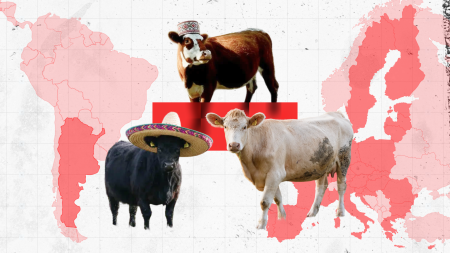
Yet the India deal is not provoking the same level of controversy as Mercosur. Farmers are not taking to the streets, and opposition among EU member states is far less intense. Why is this the case? Here’s a comparison of the two agreements.
Why Aren’t Farmers Protesting?
The EU–India deal eliminates or reduces often prohibitive tariffs—averaging over 36%—on EU agri-food exports, opening a vast market for European farmers.
For instance, India’s tariffs on wine will be cut from 150% to 75%, eventually falling to 20%. Tariffs on olive oil will drop from 45% to 0% within five years, while duties on processed agricultural products such as bread and confectionery—currently as high as 50%—will be removed entirely.
Sensitive sectors of European agriculture will remain fully protected. Products such as beef, poultry, rice, and sugar are excluded from liberalization. Moreover, all imports from India must continue to meet strict EU health and food safety standards.
In parallel, the EU and India are negotiating a separate agreement on geographical indications (GIs), which will help traditional EU agricultural products enter the Indian market by preventing unfair competition from imitations.
By contrast, the Mercosur agreement foresees the elimination of 91% of tariffs on EU goods, with preferential treatment for the remaining 7%, and the removal of 92% of EU tariffs on Mercosur products.
It also includes a bilateral safeguard mechanism, allowing for a “targeted response in the unlikely event of market disruptions directly resulting from the agreement,” according to the European Commission. This mechanism permits the temporary suspension of trade concessions if they negatively affect producers in either India or the EU.
However, unlike the India deal, Mercosur does not offer similar protections for sensitive sectors. European farmers would only benefit from import quotas and a safeguard clause, allowing suspension of import preferences if the EU market is disrupted. Many producers consider this level of protection insufficient.
As with the India agreement, products from Mercosur will still need to comply with EU consumer protection and safety standards, just like any other goods sold in the Union.
Are Both Deals at Odds with the Green Deal?
The Mercosur agreement has triggered strong criticism from Green parties and environmental groups. They warn that the deal could increase greenhouse gas emissions, accelerate deforestation in Latin America, and worsen chemical pollution. Particular concerns focus on exports of soy, beef, and bioethanol—commodities closely linked to deforestation in the Amazon rainforest.
MEPs also argue that the agreement is especially problematic in light of delays and the potential weakening of the EU Deforestation Regulation (EUDR), as well as the withdrawal of Brazilian traders from the Amazon Soy Moratorium. Without these safeguards, expanded trade with the EU could inevitably lead to higher rates of deforestation.
In 2020, an expert commission appointed by the French government to assess the draft agreement warned, in a scenario analysis, of a heightened risk of deforestation in Mercosur countries during the first years of the deal’s implementation.
Concerns surrounding the EU–India agreement are of a different nature. While it includes references to human rights and commitments under the Paris Agreement, these provisions are unlikely to be treated as “essential elements.” As a result, violations would not trigger suspension of the agreement—unlike the enforcement mechanism foreseen under the EU–Mercosur deal.
India also sought exemptions from EU climate measures such as the Carbon Border Adjustment Mechanism (CBAM), a demand the EU ultimately rejected.
This matters, NGOs argue, because discrepancies between EU and Indian environmental standards could result in carbon leakage and the relocation of production to jurisdictions with weaker environmental requirements.
According to the European Commission, the agreement nonetheless contains a dedicated chapter on trade and sustainable development. It strengthens environmental and climate protection, safeguards labour rights, promotes gender equality, and establishes a framework for dialogue and cooperation on trade-related environmental and climate issues, alongside provisions for implementation and monitoring.
Many of these commitments are legally binding and subject to enforcement through a dedicated consultation mechanism, the Commission says. The mechanism is designed to address disputes related to labour standards, environmental protection, and gender equality.
In addition, the EU and India will sign a memorandum of understanding establishing an EU–India climate cooperation platform, due to be launched in the first half of 2026. Over the next two years, the EU will also provide €500 million to support India’s efforts to cut greenhouse gas emissions and accelerate a long-term, sustainable industrial transition.
Still, environmental groups remain sceptical. They warn that dialogue-based safeguards could eventually be used to challenge ambitious climate or environmental regulations if these are framed as trade barriers, and that environmental provisions may prove too weak—and too difficult to enforce—to deliver meaningful change.
Are Germany the Main Winner?
If one country stands out as benefiting most from both the Mercosur and India trade deals, it is Germany. Its vast automotive industry is set to gain access to newly opened markets, with lower tariffs—other conditions remaining equal—translating into higher sales and increased profits for companies such as Volkswagen and BMW.
This is precisely why Berlin pushed so hard for the Mercosur agreement to enter into force. Under the India deal, other automotive powerhouses also stand to gain, notably France and Italy, home to Stellantis. Both countries are also expected to benefit from increased exports of flagship food products such as cheese (including Parmigiano Reggiano), wine, and olive oil.
France, however, opposed the Mercosur agreement, citing concerns about market disruption caused by an influx of agri-food products from Mercosur countries and increased competition for French farmers, particularly in sensitive sectors.
Italy only agreed to the deal after Ursula von der Leyen offered increased funding for agriculture in the next multiannual EU budget. Giorgia Meloni’s government was able to present this as a political success, having prevented cuts to the Common Agricultural Policy within the EU’s Multiannual Financial Framework.
And What About Poland?
Alongside France, Poland was one of the strongest opponents of the Mercosur agreement, citing the same concern: the risk of increased competition for domestic farmers. Warsaw and Paris, however, failed to assemble a qualified majority needed to block the deal.
“The government voted against the Mercosur agreement, and several of our European allies voted with us. It wasn’t enough,” Prime Minister Donald Tusk said.
When it comes to the India deal, Poland’s agriculture minister Stefan Krajewski has sought to reassure farmers, arguing that it does not pose the same level of risk to Polish agriculture as the Mercosur agreement.
“It certainly does not affect agriculture to the same extent as the deal with Mercosur countries, but we still need to see the final shape of the agreement—and that is what we are waiting for. We will respond depending on what is ultimately agreed between the European Commission and India,” he said.
On the contrary, Krajewski suggested that Polish farmers could also benefit from the agreement. “From our perspective, we are constantly looking for new markets for our apples and for our alcoholic products, which enjoy strong recognition worldwide,” he noted.