


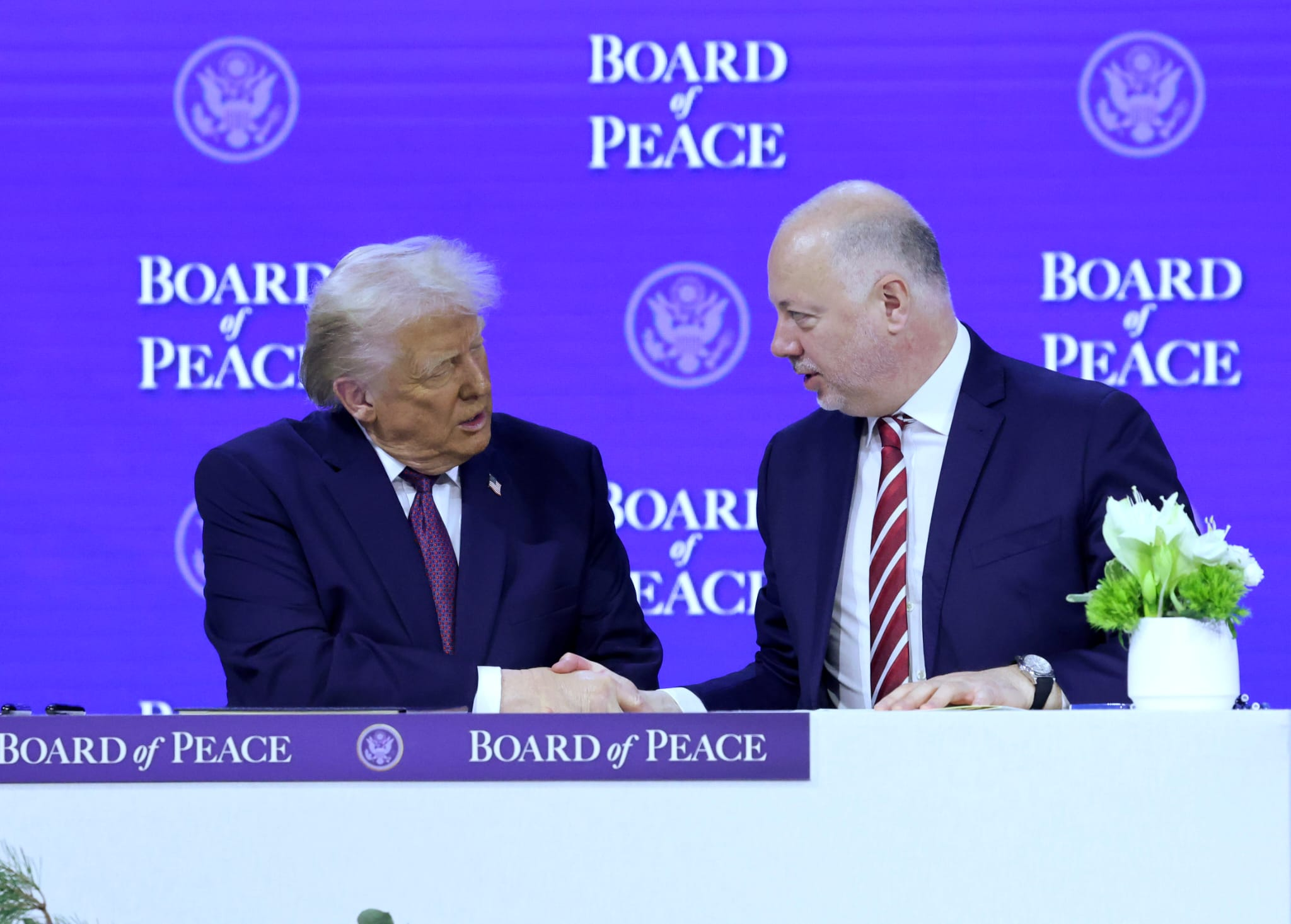
US President Donald Trump’s Board of Peace, or rather its final charter, failed to secure broad European support. A number of European leaders expressed concern that the charter does not even mention Gaza directly, and it is clear that the Board of Peace will have greater powers to resolve global conflicts – according to many, this in a sense overtakes the role of the UN.
Skepticism was also expressed by the EU’s diplomatic service, the EEAS, which stated: “The charter of the Board of Peace raises concerns under the constitutional principles of the EU.” It also noted that “the independence of the EU legal order is also an obstacle to the concentration of power in the hands of a single president.” As it became clear, Trump has proclaimed himself lifetime president of the Board of Peace, and if he decides to step down at any point, he has the privilege of personally choosing his successor.
Bulgaria and Hungary join Trump’s Board of Peace
So far, 26 countries have joined the organization, with only two of them being EU members – Bulgaria and Hungary. The first invitation for our country to join was received by former President Rumen Radev, who, however, declined it because he was in the process of resignation. Thus, on January 22, in Davos, the outgoing Prime Minister Rosen Zhelyazkov signed our country’s accession. For now, the official ratification of the document has been postponed until a future elected cabinet in Bulgaria can make the final decision. However, the signing was met with both support and criticism in Bulgaria.
Following discontent from the opposition regarding our inclusion in Trump’s initiative, our outgoing foreign minister Georg Georgiev explained that there were no violations in the decision-making process, as Rosen Zhelyazkov had been mandated by the Council of Ministers to sign the decree during the economic forum in Davos.
The ruling parties expressed their support for Bulgaria becoming a founding member of the Board of Peace. GERB deputy leader Denitsa Sacheva said she believed that Bulgaria’s entry into the Board was not contradictory to the general European position.
Realistically, if the Charter presented in Davos had been in line with the original UN Security Council Resolution 2803 from November 2025, which established the initiative, it might have met with more serious EU-wide support, even amid the tension that Washington created around Greenland. However, this remains in the realm of speculation.
Visa hopes and Gaza reconstruction
On the day of its establishment in Davos, 24 Chasa wrote that there are some important factors which, if they materialize in the future, would justify Bulgaria’s decision. First, it is believed that Bulgarian construction companies will benefit from the reconstruction of post-war Gaza. According to initial estimates, investments will total between $70 billion and $100 billion, and a large part of this money will be concentrated in construction activities in the enclave. It is believed that information has reached Sofia through diplomatic channels that the founding countries of the Board of Peace will have an advantage in this process.
It is also claimed that another positive aspect of our country being part of Trump’s initiative is the potential abolition of the US visa regime. This is a process that Bulgarian politicians have been working on for two decades, and since the abolition of visas depends on the percentage of refusals by embassies when issuing them, a closer relationship with the White House administration is a plus for us.
Our involvement in Trump’s Board of Peace might also be connected to Bulgarian diplomat Nikolay Mladenov being picked as the High Representative for Gaza. His main job will be to establish on-the-ground coordination between the Board of Peace, which will be led by Trump, and the National Committee for the Administration of Gaza (NCAG), composed of 15 independent Palestinian technocrats.
Mladenov, along with US Secretary of State Marco Rubio, envoy Steve Witkoff, Trump’s son-in-law Jared Kushner, former British Prime Minister Tony Blair, and others, are part of the Executive Board, a structure within the Board of Peace. According to the White House, each member of the Executive Board will be “responsible for a specific portfolio that is critical to the stabilization and long-term success of Gaza.”
However, European scepticism towards Trump’s ideas is unlikely to disappear, no matter how often it is repeated that the main goal is the prosperity of the enclave. Even European leaders close to the Republican rejected the invitation to join his Board of Peace. Italian Prime Minister Giorgia Meloni called the charter that the country received “unconstitutional.” Her Slovak counterpart Robert Fico was adamant that “we are not in favor of creating parallel structures (to the UN) for which we do not know the details.” He also pointed out that the country “will never spend membership fees to join such institutions.”
However, Arab countries voiced a different opinion compared to European nations. An Arab League official stated that participation was dictated by pragmatism. “If this body is going to decide how Gaza will be rebuilt, we cannot afford to be outside it,” the official noted. According to experts, participation, even within an imperfect system, is better than watching decisions being made from the sidelines.
According to some political analysts, Trump has other goals behind his Board of Peace, like bringing in middle powers to stop other multilateralism efforts in which he won’t have a say. Perhaps that is why, after Canadian Prime Minister Mark Carney spoke about such alliances in his speech in Davos, Trump rushed to withdraw Canada’s invitation to the Board. But like many other uncertainties surrounding the Republican’s decision-making process, this remains in the realm of speculation.