

The European Commission has not included Slovakia among the countries that may obtain an exemption from migration solidarity. Slovak Ministry of the Interior has asked for a review. The Commission will decide by the end of the year.
The Ministry of the Interior wants Slovakia to be granted an exemption from migration solidarity. It has asked the European Commission to include Slovakia among the countries facing a serious situation so that it would not have to provide assistance.
The Commission did not originally include Slovakia on this list. Countries such as the Czech Republic and Poland, which have accepted larger numbers of Ukrainian refugees, were included. As a result, they will not have to accept migrants or send a financial contribution.
However, countries that were not included on the list also have the right to request an exemption if they believe they belong there. Slovakia did so at the end of November.
“The main reason is the fact that we are also receiving displaced persons from Ukraine on a daily basis, supporting them and creating suitable conditions for their stay in Slovakia. Another risk is a further wave of migration along the so-called Western Balkan route,” the Ministry of the Interior states.
How the new solidarity works
The Member States have adopted the New EU Pact on Migration and Asylum, which also includes a solidarity mechanism. Coastal countries must process far higher numbers of entries to their territory than landlocked countries.
The solidarity reserve divides Member States into three main groups. The first consists of countries exposed to migration pressure that need urgent assistance. Next year, this group will include Greece, Cyprus, Spain, and Italy.
The second group comprises countries facing a serious migration situation, mainly because they have accepted larger numbers of people from Ukraine over the past five years. These countries will be able to request a reduction or complete cancellation of their obligation to provide assistance.
States that are not included on this list should help Greece, Cyprus, Spain, and Italy—either by relocating migrants to their territory, providing a financial contribution, or offering so-called alternative solidarity measures.
In addition, the Commission has identified countries that are not yet under migration pressure but are at risk of it. For these countries, little will change for now; they will simply be monitored more closely and will be entitled to some less significant support instruments.
The European Commission decides which group a country belongs to on the basis of data. It also proposes the numbers of relocations or financial contributions, but the final say rests with the Member States. The mechanism will apply for the first time on 12 June 2026.

What this means for Slovakia
On 12 November, the European Commission presented the results of its assessment. Based on statistics, it divided countries into those that will receive assistance, those that will provide it, and those that will be able to request an exemption.
Slovakia was not included among the countries facing a serious migration situation. From next year, it should therefore choose whether it will help by relocating migrants to its territory, providing financial assistance, or offering alternative assistance, such as deploying experts, training them, or providing material support.
The specific figures for individual countries are not yet known. Member States have published only the size of the overall support envelope, which is to consist next year of 21,000 relocations or EUR 420 million.
We will learn exactly how much Slovakia is to contribute only once the EU Council formally adopts the implementing decision, which should happen before the end of 2025. At present, legal scrutiny and official translations are under way.
What Slovakia is requesting
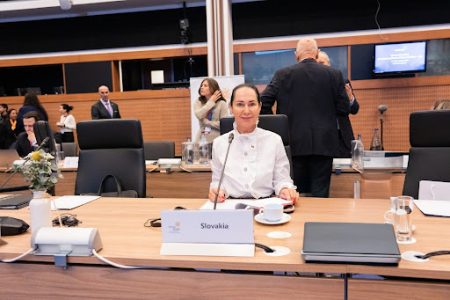
Slovakia, represented in the EU Council by the Ministry of the Interior and its head Matúš Šutaj Eštok (Hlas-SD), rejected the solidarity reserve as currently designed. However, migration matters are decided by qualified majority, so Slovakia’s opposition did not block the decision.
“I emphasized to my colleagues that I do not understand why Slovakia was not included among the countries eligible for a possible exemption, given that we have accepted tens of thousands of refugees from Ukraine. That is also why we could not support this part relating to the pact on irregular migration,” Šutaj Eštok said after the meeting.
Slovakia therefore made use of the option provided for in the migration pact. It declared that it considers itself a country facing a serious migration situation, even though it was not included on the list by the European Commission, and requested a reduction of its solidarity contribution.
It did so in a letter addressed to the European Commission on 26 November and at the same time asked the Commission for an explanation of the methodological procedure used in assessing the migration situation.
“The Commission is assessing this request and will inform Parliament and the Council of the results in due course, in accordance with the procedure laid down in the Regulation on Asylum and Migration Management,” a spokesperson for the European Commission said.
What will happen next
When drawing up the original list of countries facing a serious migration situation, the European Commission relied on migration data. It notes that it also discussed this process with the Member States.
The published methodology shows that the Commission looked back five years and examined the number of migrants admitted, including those from Ukraine who were granted temporary protection, as well as the numbers of applications for international protection and the numbers of decisions. It also examined how many people a country refused entry to, ordered to leave, and whether the country has any specific circumstances, for example bordering Russia, which uses refugees as a weapon.
This year, the Commission included six countries on the list of those facing a serious migration situation: Bulgaria, the Czech Republic, Estonia, Croatia, Austria, and Poland. These countries were able to request a full or partial reduction of their solidarity contributions.
The governments of the Czech Republic and Poland practically immediately announced that they had requested and obtained a complete removal of their contributions. Information on Bulgaria, Estonia, Croatia, and Austria has not yet been confirmed; in theory, they may have decided not to apply for an exemption. We will know at the latest when the decision is formally published.
At the same time, however, we know that Slovakia has applied for an exemption. In its response, the Ministry did not specify whether it was seeking a full or partial reduction. The Minister, however, stated that he rejects mandatory relocations or mandatory financial contributions. It can therefore be assumed that Slovakia does not wish to contribute at all.
Since Slovakia is not among the countries that the European Commission itself identified as facing problems, its request had to be more detailed. Slovakia should “properly substantiate” the justification for the seriousness of its migration situation.
The Commission has four weeks to assess this request. The outcome should therefore be known by the end of the year. If the assessment is positive, the question of whether Slovakia will receive a reduction in its contribution will still be voted on by the Member States. Approval will again require a qualified majority.
What chances does Slovakia have
Although we know what information the European Commission examines, we do not know the exact formula according to which it decides. However, the November decision shows what information convinced the Commission in the case of the six Member States it included on the list.
In Bulgaria’s case, this is a high number of registrations for temporary protection and applications for international protection, as the country approved many of them and also rejected many, which meant it had to invest in returns.
In Croatia, it is also a high number of returns relative to GDP and population size; the country is also experiencing a higher number of irregular entries into its territory.
For Poland and the Czech Republic, the key factor mentioned is mainly the number of people granted temporary protection after fleeing Ukraine, relative to their size. In Estonia, this is combined with a high number of applications for international protection and a high rate of positive decisions.
It is virtually certain that in Slovakia’s case the Commission will not take into account the number of applications for international protection, as Slovakia receives barely two hundred per year. This is a very low figure even for a country of its size.
However, the number of people fleeing Ukraine who have been granted temporary protection in Slovakia is relevant. According to the latest data, there are around 130,000 such people in Slovakia. Given the size of GDP and the population, this is a large number. Only Poland and the Czech Republic have a higher ratio.
If Slovakia does eventually obtain an exemption, it will most likely be due to this aspect of migration policy. However, this is not guaranteed. The fact that our capacity to provide assistance has been exhausted must be defended before the European Commission, which has already once decided negatively on the same issue.