

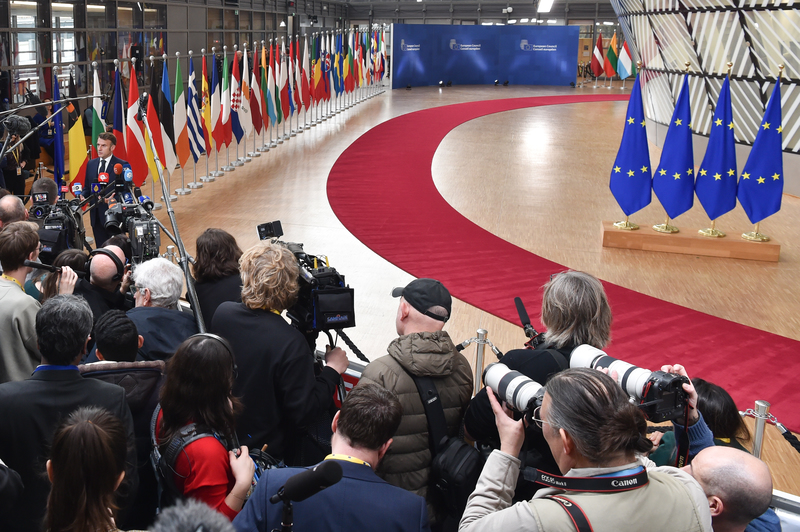
EU leaders at the summit approved a key €90 billion loan for Ukraine. However, Hungary, the Czech Republic and Slovakia refused to assume financial responsibility for the joint loan.
“By doing so, Robert Fico’s government is sending a signal not only to partners in the EU but also to its own citizens that our relationship with the Union is purely transactional,” Ivan Korčok told EURACTIV Slovakia in response.
Negotiations lasting until three in the morning produced a result. After lengthy debates and major concessions, European leaders finally agreed on further financing for Ukraine. Otherwise, the country would have “run out of steam” to manage the state and its defense as early as April next year.
The original proposal—to use the cash value of frozen Russian assets amounting to €210 billion—did not pass. Opposition came primarily from Belgium, where up to 90 percent of these assets are held, as well as from several other countries, including Slovakia. The most common concerns related to potential legal consequences or possible retaliation from the Kremlin.
The EU therefore decided to provide Kyiv with a loan for the next two years through a different mechanism. Late at night, European Council President António Costa informed the public on X: “We have an agreement. We have approved a decision to provide support to Ukraine in the amount of €90 billion for the years 2026–2027. We have fulfilled what we committed to.”
“I am grateful to all EU leaders for this decision,” said the president of the country at war, Volodymyr Zelensky, on X. “Together, we are defending the future of our continent.”
This loan will help Ukraine finance both its battlefield needs and the country’s day-to-day operations. Overall, it should help cover roughly two thirds of Ukraine’s costs for the period 2026–2027.
Assistance from the Union will work in such a way that the EU will jointly borrow on the capital markets, with the loan guaranteed by a reserve in the EU’s common budget. Hungary, Slovakia and the Czech Republic, however, refused to share in the financial responsibility for the joint loan.
The current leaders of these countries – Viktor Orbán, Robert Fico and Andrej Babiš – met again at the summit after a pause of several years, as Andrej Babiš’s government was appointed only this month. All three consulted and coordinated their positions during the 15-hour negotiations and even released a joint photograph. During the talks, however, one minor difference between them emerged.
Babiš repeatedly tried to distance himself
Although all three countries secured an exemption from the EU, the conclusions of the European Council on the loan were signed by 25 member states. Only Hungary and Slovakia did not join them, as they refused any form of support.
During the night of Friday (19 December), Babiš stressed to journalists that the Czech Republic views the issue differently. “We do not have the same position as Slovakia and Hungary. We support Ukraine. We supported the conclusions, with the sole exception that we do not want to guarantee the loans,” Babiš said after the Council meeting.
“Besides Slovakia and Hungary, the Czech Republic also did not join the guarantees, but Czech Prime Minister Andrej Babiš clearly emphasized that the Czech position on Ukraine and Russian aggression is fundamentally different from the positions of Budapest and Bratislava, thereby politically distancing himself from them,” former foreign minister Ivan Korčok (PS) told the EURACTIV Slovakia portal.
Babiš’s attempt to distance himself also came a week earlier, when he insisted that he was “not in any club” with Fico and Orbán. The Czech opposition, however, views the actions of their successors in government differently.
“Babiš claimed he would not conduct politics in the style of Orbán and Fico. It lasted exactly one week, and at his very first European Council he was already singing from the same songbook with them,” commented former Czech prime minister Petr Fiala. According to him, Babiš is setting a new course in foreign policy in which the Czech Republic will “lose dignity, respect, and eventually money.” “And unfortunately, it is heading east,” he added.
It was precisely the close coordination of the “Visegrád trio” that contributed to concerns already present before Babiš’s return to power – that the number of EU states inclined to undermine the unity of the 27 would once again increase.
Babiš’s position appears unclear and wavering. Before the elections, he repeatedly questioned the continuation of the Czech ammunition initiative and also repeatedly argued that money for Ukraine should instead be used at home.
Czech political scientist Vladimíra Dvořáková said in an October interview with EURACTIV Slovakia that Babiš is not politically aligned in the same way as Orbán and Fico. However, she assumed that he would draw inspiration from them in certain respects.
“Slovakia as a free rider”
According to Korčok, the fact that the EU ultimately found an agreement should clearly be welcomed, as it was a crucial matter in the current security situation.
“Let us set aside for now that this is not a loan backed by frozen Russian assets—those remain frozen, and Russia will not gain access to them until it ends the war and pays reparations. What matters is that the Union was able to act and did not leave Ukraine at the mercy of the aggressor,” the former minister said.
Like the rest of the Slovak opposition, however, he criticizes Slovakia’s stance at the summit.
Slovak Prime Minister Fico had already firmly rejected the idea of using frozen Russian assets to help Ukraine at the beginning of November. He explicitly ruled out their use to finance Kyiv’s military needs, saying he would support their use only for post-war reconstruction.
“As long as I am prime minister, the Slovak Republic will not participate in any legal or financial mechanisms aimed at confiscating frozen assets that would end up as military expenditures for Ukraine,” he said in November on STVR’s Saturday Dialogues.
He reiterated this view at a meeting of the Committee for European Affairs before departing for the summit. “In principle, I refuse to support anything tomorrow that would lead to money for war,” Fico said on Wednesday (17 December).
He justified his position with a narrative he has repeated since the start of his fourth term in office—that military assistance to Ukraine allegedly “only prolongs the war.” The fact guiding the overwhelming majority of the West, however, is that if Russia stopped fighting, the war would end; by contrast, if Ukraine stopped fighting, it would cease to exist as we know it.
According to Korčok, Slovakia chose at the summit the position of a country that “is not part of the solution and in practice behaves like a free rider.” “By doing so, Robert Fico’s government is sending a signal not only to partners in the EU but also to its own citizens that our relationship with the Union is purely transactional—based on money, which clearly does not bother it even in a situation where Slovakia is simultaneously profiting from arms exports to Ukraine.”
Since autumn 2023, Slovakia has refused to provide military assistance to Kyiv at the state level and supports only humanitarian activities. Nevertheless, on a commercial basis, the flow of weapons to Ukraine has increased significantly under Fico’s government.
Investing in Ukraine is an investment in the EU
If any problem were to arise now in the implementation of the approved loan, according to Korčok it would not stem from the EU’s position as such, but from the political inconsistency and lack of credibility of certain member states.
“Moreover, it is now clear that the defense of Slovakia is a higher priority for 24 EU countries than for its own government. This is not only politically short-sighted but also hypocritical,” the former minister added.
European Commission President Ursula von der Leyen has repeatedly emphasized that at present “there is no more important act of European defense than supporting Ukraine’s defense.”
According to experts, Ukraine, through its resistance against Russia, is also protecting Europe. To prevent the Kremlin’s military actions from in the future extending beyond NATO’s borders, they argue that it is essential that Russia does not emerge from peace negotiations as the winner.