

The European Parliament has adopted a resolution on so-called “Military Schengen.” What is it about — and why is it seen as a key element of protection against a potential threat from Russia?
MEPs have backed a resolution calling for the creation of a military version of the Schengen area. The idea is to remove internal barriers to the movement of troops and military equipment across the EU, alongside large-scale upgrades of railways, roads, tunnels and bridges.
“There are still many obstacles hindering military mobility in Europe,” the European People’s Party (EPP), the largest political group in the European Parliament, has warned while pushing for the initiative. “Bridges are often too weak to carry heavy tanks or too low for military convoys to pass underneath. Rail systems suffer from incompatible track gauges. Moving personnel and equipment across borders involves extensive bureaucracy.”
“The war of aggression launched by Russia against Ukraine has once again highlighted military mobility and the urgent need to enable the rapid cross-border movement of troops, equipment and assets across Europe,” MEPs stressed in the adopted resolution.
They underlined that military mobility is a cornerstone of common European security and defence, and of particular importance for the security of the EU’s eastern flank — especially the Baltic states and Poland.
According to the resolution, military mobility within the EU “significantly strengthens the security and resilience of all 27 member states,” including in the face of growing acts of sabotage against critical infrastructure and escalating hybrid threats.
“To maintain Europe’s strength and ability to deter aggressors, it is crucial we demonstrate our readiness to act. This includes having the capacity to deploy troops and equipment rapidly throughout the EU” said Petras Auštrevičius, a Lithuanian MEP from the Liberal Movement (Renew Europe) and co-rapporteur on the file.
“Currently, there are far too many hindrances to military mobility that could be quickly addressed without requiring much funding. Military mobility has become even more urgent in light of Russia’s war of aggression against Ukraine. There is no time to waste – we must keep up the momentum and reach for the low-hanging fruit.” added co-rapporteur Roberts Zīle, a vice-president of the European Parliament from Latvia’s National Alliance (European Conservatives and Reformists).
A military Schengen zone
In the resolution on military mobility, the European Parliament acknowledged that while progress has been made, serious administrative, financial and infrastructure barriers remain. As a result, transporting military equipment across the EU can sometimes take more than a month.
MEPs voiced “deep concern over the lack of efficiency and effectiveness in military mobility,” attributing it to regulatory and procedural hurdles, as well as insufficient harmonisation that leads to slow coordination and wasted time.
They called on EU member states and the European Commission to step up investment in transport infrastructure, particularly along the EU’s four military mobility corridors. The resolution also urges wider use of digital solutions and faster cross-border permits through a “one-stop shop” system.
To support the creation of “Military Schengen,” MEPs propose setting up a military mobility task force and appointing a European coordinator to streamline implementation. The Commission would be tasked with presenting a detailed roadmap.
The resolution was adopted by 493 votes in favour, with 127 against and 38 abstentions. MEPs from the transport and defence committees will now begin legislative work on a military mobility package prepared by the European Commission.
The Commission’s proposal
The European Commission and EU foreign policy chief Kaja Kallas presented the military mobility package, including a regulation on “Military Schengen,” in November. It aims to remove regulatory barriers by introducing harmonised, EU-wide rules on military mobility.
The Commission also proposes launching a European Military Mobility Enhanced Response System (EMERS), designed to speed up procedures and support armed forces operating within the EU or NATO.
Another goal is to boost the resilience of transport infrastructure by upgrading key EU military mobility corridors to dual-use standards and protecting strategic infrastructure, alongside investments in cybersecurity, energy security and crisis preparedness.
The Commission plans to enhance member states’ readiness by creating a Digital Military Mobility Information System. It also wants to establish a new Military Mobility Transport Group and strengthen the TEN-T framework. National coordinators for cross-border military transport would be appointed in each member state to support implementation.
‘Proper funding is essential’
“Overcoming administrative burdens and developing dual-use capabilities and infrastructure is not a luxury — it is a necessity,” Auštrevičius stressed, noting that much work remains to achieve a truly functional “Military Schengen.”
“This goal must be delivered as quickly as possible,” he added.
Transport infrastructure must be strengthened for both military and civilian purposes and made resilient to drone attacks, cyberattacks and other forms of armed action, argued Wouter Beke, who negotiated the report on behalf of the EPP in the Security and Defence Committee (SEDE). He cautioned, however, that this will require adequate funding in the EU’s next long-term budget.
“From unloading in our western ports to potential deployment on the eastern front, we must be sure that we are prepared and capable of decisive action whenever needed,” Beke said.
The Parliament welcomed the Commission’s proposal to increase funding for military mobility to more than €17 billion in the next multiannual budget, urging member states not to repeat the cuts seen in the 2021–2027 budget, when funding was ultimately slashed by three-quarters.
According to the Parliament, modernising around 500 infrastructure bottlenecks — such as bridges and tunnels — will cost at least €100 billion. MEPs are therefore calling on the Commission to simplify access to funding for dual-use projects.
Poland’s and Europe’s security
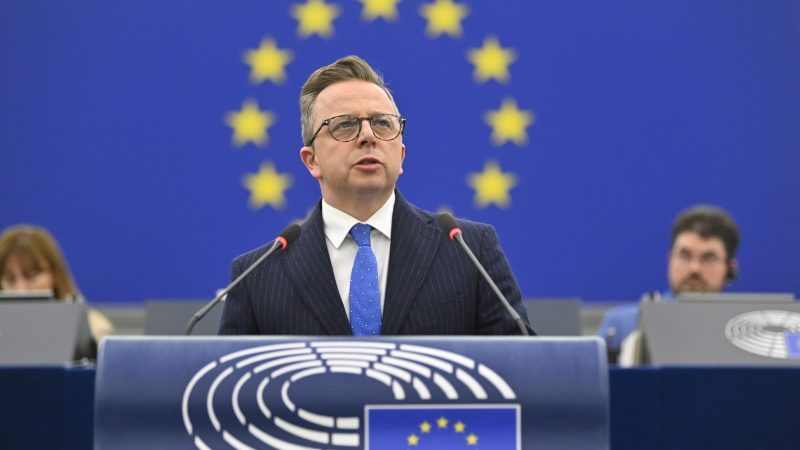
“Military mobility today means real security for Europe. It is the foundation of European security. The key factor is reaction time — if you cannot quickly move troops and equipment, you are not ready to defend,” said Dariusz Joński, an MEP from Poland’s Civic Coalition (European People’s Party), during the parliamentary debate. Joński negotiated the report on behalf of the Transport and Tourism Committee (TRAN).
“We need Military Schengen now. In a situation of war threat, the army cannot wait at the border for 45 days for a permit,” he said.
He stressed the need for investment in dual-use infrastructure — roads, railways, ports, airports and digital networks. “This is not a luxury. It is a necessity and a form of resilience against sabotage, cyberattacks and hybrid pressure,” he added, pointing to recent sabotage attempts in Poland, Romania and near the UK as proof that “the threat is here and now.”
“Europe no longer has the luxury of delaying preparations for a war that Russia wants, is striving for and will sooner or later attempt to trigger,” said Kosma Złotowski, an MEP from Poland’s Law and Justice party (European Conservatives and Reformists), in the same debate. He noted that in peacetime, roads, airports and ports are just infrastructure — but in times of threat, they become critical elements of the security system.
Both Polish MEPs called for simplified rules and increased investment to facilitate troop movements, the transport of heavy equipment and the reception of allied assistance.
One strategically important project, according to Złotowski, is the Via Pomerania road, which would link Poland’s coast with Bydgoszcz and Inowrocław. The route would play “a very important role for Polish — and above all European — security,” he said, urging the Commission to find funding for such projects crucial to military mobility.