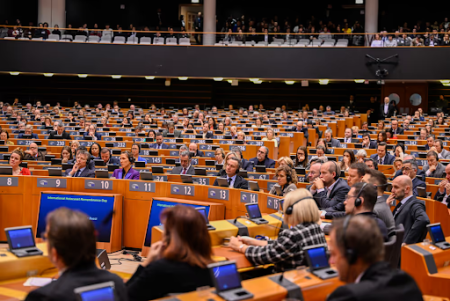



At December EU summit, leaders failed to reach an agreement on launching the so-called reparations-based loan for Ukraine, despite strong support for the idea from Poland. Polish Members of the European Parliament also agree that this solution would be preferable to the EU taking on new joint debt.
EU leaders were expected to approve the reparations-based loan for Ukraine. The mechanism was to be backed by assets of the Russian central bank that have been frozen since the first days of Russia’s war against Ukraine. Kyiv would only begin repaying the loan once it received war reparations from Russia.
However, Belgium opposed the proposal. Its position proved decisive, as the majority of the frozen Russian assets — worth around €185 billion — are held by Euroclear, a Belgian-based financial services company. Belgian authorities fear that if sanctions are lifted in the future, Russia could pursue legal action to reclaim the assets, forcing Belgium to cover any losses from its own budget.
At the end of last month, Belgian Prime Minister Bart De Wever sent a letter to European Commission President Ursula von der Leyen, hardening his opposition to the Commission’s plans. “I will never commit Belgium to bearing the risks on its own and exposing itself to threats arising from the reparations loan option,” De Wever wrote.
The proposed loan was to amount to €90 billion, covering roughly two-thirds of Ukraine’s financial needs over the next two years. As a supplement — or an alternative should agreement fail — the EU would jointly raise funds on the financial markets. This debt would be secured by the EU’s next multiannual financial framework.
De Wever argued, however, that the EU should opt for common borrowing rather than a loan backed by Russian assets. Supporters of the reparations-based loan, including Germany, oppose this approach, warning against further strain on national budgets.
Belgium was not alone in objecting to the proposal. Italy, the Czech Republic — now governed by Andrej Babiš — and Hungary were also among the countries voicing opposition.
Winners and Losers
Early Friday morning, European Council President António Costa announced that leaders had agreed only on a €90 billion loan to cover Ukraine’s short-term needs until 2027. At the same time, he confirmed that work on the reparations-based loan — consistently blocked by Belgium — would continue.
“I am pleased that common sense has prevailed and that we have secured the necessary resources, using a solution with solid legal and financial foundations,” Italian Prime Minister Giorgia Meloni said.
For Andrej Babiš, the key issue was ensuring that not all EU member states would be required to guarantee the loan — a demand pushed by Belgium, which fears being left alone to return assets if Russia sues.
“I supported the conclusions and ensured that the Czech Republic will not guarantee this loan — exactly as I promised,” Babiš wrote on X after the summit.
De Wever was also satisfied. “Ukraine, Europe and financial stability have won. We have achieved a stable, legally justified and financially credible European solution,” he wrote.
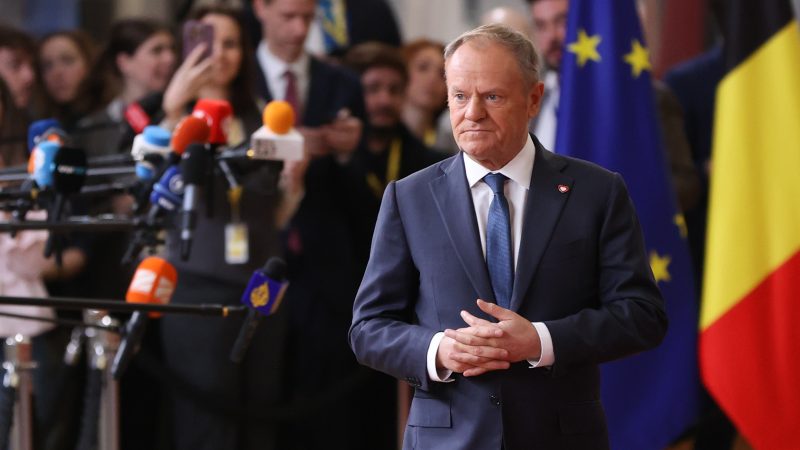
Polish Prime Minister Donald Tusk, however, described the outcome as bittersweet from his perspective. He noted that summit conclusions leave the door open to revisiting the idea of a loan backed by Russian assets in the future.
“Despite excessive caution from some leaders, Europe has decided to finance Ukraine. The option of using frozen Russian assets still exists,” Tusk said.
“Am I fully satisfied? Of course not. But it is always better to have something than nothing,” he added in an English-language post.
‘Russia Must Feel the Consequences’
Polish MEPs across the political spectrum — from the Left to the far-right Confederation party — told EURACTIV.pl that a loan secured by Russian central bank assets would be a better solution than issuing new joint EU debt.
“Ukraine must be free — there is no doubt about that,” said Bogdan Rzońca, an MEP from Poland’s Law and Justice party (ECR). “At the same time, Ukraine must effectively tackle corruption, as it directly affects both the scale of aid and trust in how it is used. No one wants to provide funds that could later be misappropriated.”
Rzońca supports the idea of a loan secured by Russian assets. “We believe that once legal uncertainties are resolved, these assets should be used for Ukraine’s reconstruction,” he said.
In his view, granting such a massive loan without tapping Russian resources would be a mistake. “Russians must understand that aggression has real financial consequences and that the invasion of Ukraine comes with serious economic costs,” Rzońca stressed.
Will Belgium Ever Agree?
Anna Bryłka, an MEP from the Confederation party (Patriots for Europe), also believes a reparations-based loan would be preferable to joint EU borrowing. However, she considers it unlikely that Belgium will ultimately agree.
“On top of that, guarantees are expected from all member states, which is not a good solution,” she added.
One of the strongest advocates of the reparations-based loan is Michał Kobosko, an MEP from Poland 2050 (Renew Europe). “As we can see, Ukraine can no longer count on support from the United States. European assistance is also constrained by budgetary pressures in many member states. Meanwhile, Ukraine needs funds to continue its defensive war against the brutal aggression of the Russian dictator,” he said.
As Kobosko noted, for now “we cannot dream of what is obvious from the perspective of international law” — namely, Russia paying war reparations for the destruction it has caused. “That is why frozen assets should be used not to hand over money directly, but as collateral for a loan to Ukraine,” he concluded.