


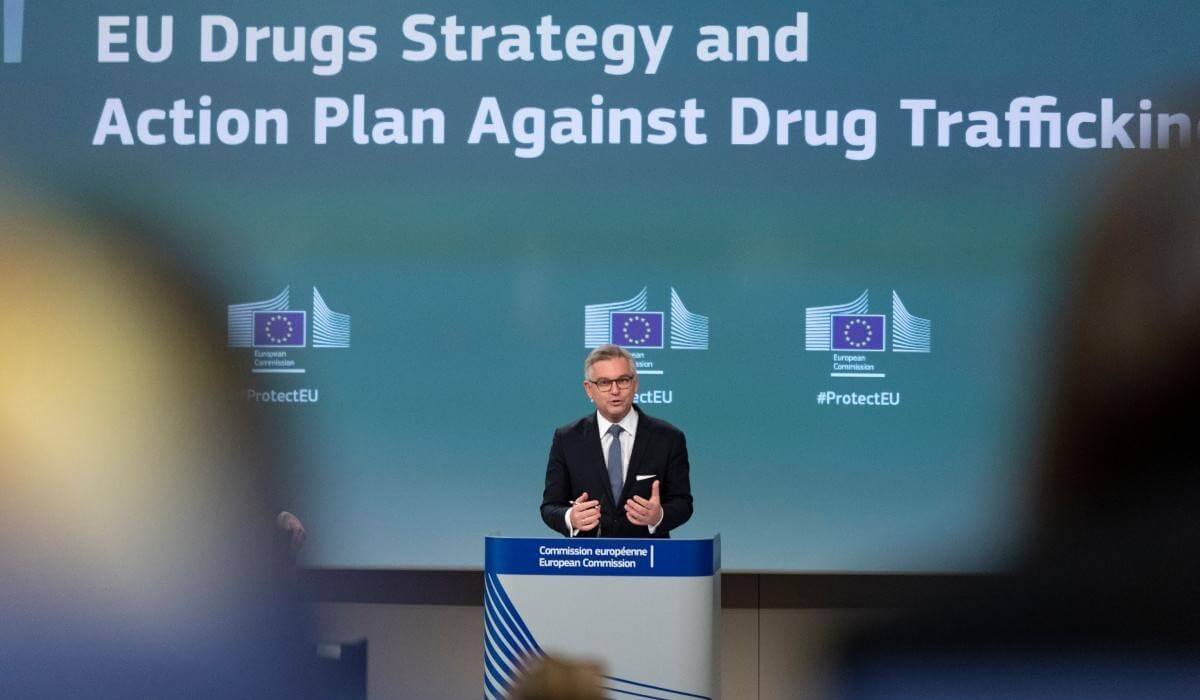
The European Commission has presented a new anti-drug package aimed at fighting the illegal drug trade. The fight is meant to be based on prohibition. According to Czech drug policy expert Jindřich Vobořil, this approach is ineffective, and the proposal is unbalanced.
Criminal organisations are quickly adapting to new methods and trafficking routes. The European Commission has therefore presented a new strategy and an action plan, with which it aims to intensify the fight against drugs and organised crime.
Leading Czech expert on drug policies is critical towards the recently proposed package.
“EU drug policy is moving more in circles than along a genuine trajectory of progress,” says former Czech national drug coordinator Jindřich Vobořil, assessing the Union’s efforts so far. In his view, the current proposal does not differ significantly from the existing prohibition-based approach.
“Over 70 years of European and global experience show that prohibition does not reduce demand or harm. On the contrary, it creates a highly risky environment, fuels violence, stigmatisation and human rights violations, and at the same time increases the power of illegal markets,” he states.
Fighting Organised Crime as a Key Pillar
Among the key elements of the proposal is intercepting drugs at the EU’s external borders, in ports and at sea. In the Mediterranean, the Commission wants to expand the operations of the Maritime Analysis and Operations Centre – Narcotics. It is responding to the fact that the region is becoming a major trafficking corridor. When it comes to detecting drugs at the external borders, Frontex and Europol are to step up their support to Member States.
Ports are also an essential gateway into Europe for traffickers. The Commission has therefore announced that it will draw up a new strategy to strengthen their security and resilience. At the same time, it wants to bolster the resilience of ports in third countries from which drugs are shipped. The Union is thus seeking more intensive cooperation with third countries, including the creation of joint investigation teams.
“The section on tackling drug markets and organised crime is elaborated in great detail, with specific tools and institutional responsibilities,” Vobořil notes. “By contrast, the part devoted to prevention, harm reduction and social integration remains vague and largely declaratory.”
Cooperation is also to be strengthened between authorities at the Member State level and the EU level. Europol is also tasked with supporting national bodies in investigating online drug sales.
In the digital space, however, the Commission also wants to tackle the recruitment of minors by criminal gangs. The plan is to establish a platform bringing together experts for collaboration and knowledge exchange. This should be accompanied by tools designed for early detection, intervention and building resilience against recruitment.
Strengthening the EUDA
The European Union Drugs Agency (EUDA) is a key player in the fight against narcotics. The European Commission aims to strengthen its mandate so that it can better support Member States in preparedness and response to drug-related threats.
Under the strategy, the agency is to provide Member States with information from a new database of substances. It is also to assess threats related to highly potent synthetic opioids.
To provide early warning to Member States, the EUDA will upgrade the current alert system, and a European Drug Alert System is to be set up in the area of health and security.
Through the agency, the Commission also wants to monitor precursors – substances that criminal organisations use to manufacture drugs. According to the Commission, the new rules should make their control and monitoring clearer, simpler and more digital.
In addition to tighter control, the proposal also envisages banning certain so-called designer precursors. These are chemicals deliberately designed so as not to fall under the list of controlled substances, while still allowing the production of drugs.
An Unbalanced Proposal?
Jindřich Vobořil considers the proposal deeply unbalanced. In his view, the strategy does not work with regulated market approaches, even though experience from some countries shows that such models can reduce not only health harms but also social harms.
However, the strategy also contains measures he views positively. “These include, in particular, the emphasis on high-quality and voluntary treatment, better coordination between health and social services, recognition of the importance of mental health care, and the explicit mention of key harm reduction tools such as supervised consumption rooms, naloxone distribution, needle and syringe programmes and drug checking. It is also positive that the strategy explicitly recognises the role of civil society and user groups in designing and providing services,” his position paper states.
Although the Commission expects the proposal to reduce drug-related crime, Vobořil does not foresee such an effect. In his view, these measures will not deliver the desired outcome.
“Crime and violence associated with drugs are not primarily caused by the mere existence of psychoactive substances, but above all by their criminalisation. It is precisely the prohibitionist regime that creates highly profitable illegal markets, which naturally attract organised crime, generate violence and weaken the rule of law.”