


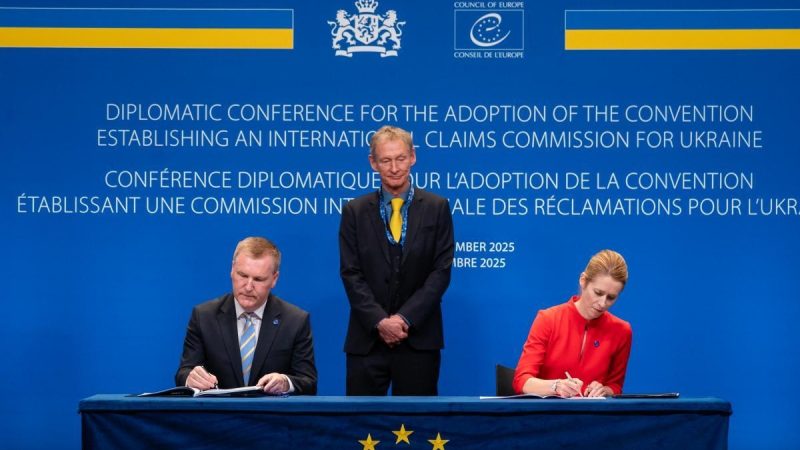
A new compensation mechanism for victims of Russian aggression has been launched in The Hague. The damage register has already recorded more than 80,000 claims, while Brussels is pushing for the use of frozen Russian assets.
The European Union has formally joined an international convention establishing a claims commission for Ukraine. The signing ceremony took place in The Hague, attended by EU High Representative for Foreign Affairs Kaja Kallas and Commissioner for Justice Michael McGrath.
“This is another step in building a mechanism designed to ensure compensation for Ukraine for the damage caused by Russia,” it was emphasised during the ceremony.
Kallas noted that damage to property represents only one category in the damage register — and the least costly one.
“How do we put a price on the killing of family members, the deportation of children, life-changing injuries, sexual violence, or torture? These are the questions the claims commission will be grappling with in the years ahead,” Kallas said.
The scale of destruction in Ukraine is dramatic. As Kallas pointed out, “after four years of war, more than 200,000 buildings have been destroyed or damaged, and around 2.5 million homes and apartments are no longer fit for habitation.”
“We are talking about a situation in which all residents of The Hague would have to leave their homes twice over. The scale of destruction and its impact on citizens are unimaginable,” the EU’s top diplomat added.
One million euros to launch the commission
Following the formal adoption of the convention, the EU committed to providing up to €1 million for the preparatory work of the claims commission. The damage register, launched in May 2023, remains open, and Ukrainians can continue to submit claims.
Commissioner McGrath described the signing of the convention as a “watershed moment” in delivering on commitments to Ukraine.
“We are moving from principles to action, from aspiration to reality, placing accountability at the very heart of Ukraine’s future,” he said.
As he recalled, more than three years ago the UN General Assembly reaffirmed a clear principle: Russia must bear full responsibility for its unlawful actions against Ukraine and pay reparations for the damage caused.
Frozen assets as a source of funding
The key challenge remains securing funding for compensation payments. Kallas pointed to the precedent set by the UN Compensation Commission, which used revenues from Iraqi oil exports to compensate victims following Iraq’s invasion of Kuwait.
“Russia bears no less responsibility for the damage in Ukraine than Iraq did for the damage in Kuwait. But Russia will never voluntarily pay for the destruction it has caused,” Kallas said.
She stressed that Russian state assets worth between €260 and €280 billion have been frozen outside Russia.
“It is inconceivable that this money should ever return to Russia, given the damage it has caused — and continues to cause — by refusing to lay down its arms. This is the most obvious basis for a compensation fund,” she added.
Commissioner McGrath explained that the convention sets out a clear path towards establishing such a fund.
“The European Commission’s proposal for a reparations loan recognises that these resources can be used directly by Ukraine to pay compensation awarded by the claims commission,” he underlined.
Power and money instead of human life
European decision-makers are currently considering the issue of frozen Russian assets, most of which are located in Europe.
“These Russian assets can and must be fully used to defend against Russia’s own aggression. The aggressor must pay,” Ukrainian President Volodymyr Zelenskyy said.
As he added, the decision on Russian funds is also about restoring justice: “It is about restoring justice — in a way that Russia will truly feel.”
According to the Ukrainian leader, the Putin regime does not value human life.
“Putin does not believe in people. He believes only in power and money. Russians do not count their dead, but they count every dollar and every euro they lose,” Zelenskyy said.
That is why, he stressed, a strong decision on Russian assets is necessary.
“These funds must be used to defend against Russia,” he added.
Accountability as a condition for lasting peace
Kallas warned against attempts to exclude reparations from potential peace negotiations.
“We are already seeing attempts to exclude reparations — or, in fact, any form of accountability — from possible peace agreements. This places an enormous responsibility on the international community,” she stressed.
Michael McGrath emphasised that accountability for perpetrators and reparations for victims are essential to achieving a just and lasting peace.
Although the geopolitical landscape has changed profoundly, Ukraine’s determination to resist Russian aggression remains unchanged — as does the European Union’s unwavering commitment, he added.