


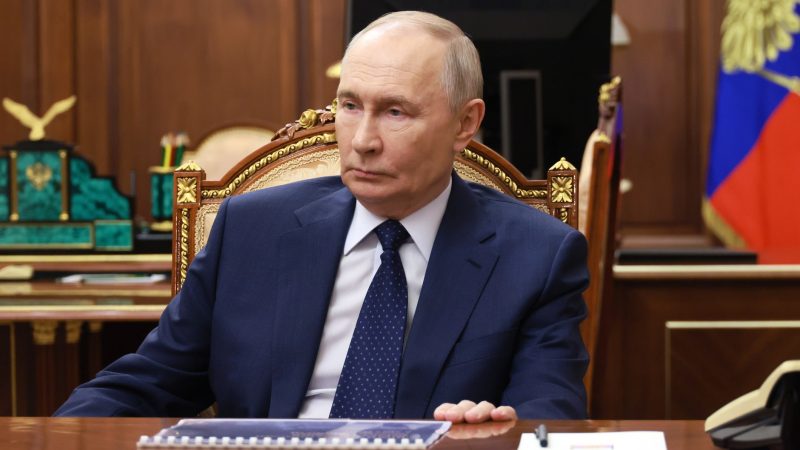
The Russian government rejects claims that financial constraints are preventing the country from continuing its military operations. Moscow is actively strengthening its defense industry, and weapons tested on the front lines have attracted interest from numerous countries, according to Deputy Prime Minister Denis Manturow, who discussed the matter with President Vladimir Putin.
The meeting focused on industrial development trends in 2025 and projections for the future.
According to Denis Manturow, Russian industry ended 2025 with growth of around 3 percent, though official and detailed statistics are expected in February. Strong performance was reported in pharmaceuticals, medical industries, and radio electronics, while sectors sensitive to demand drops saw weaker results.
Over the first three quarters of 2025, investment in manufacturing grew by 23 percent, totaling roughly 5 trillion rubles. Manturow attributes much of this to government and business efforts focused on national projects funded by the state budget.
Despite EU sanctions, Russian exports continue to rise. Over ten months last year, exports reportedly increased 18 percent, with 80 percent directed to so-called “friendly countries,” up from 60 percent before 2022. The most active markets include Africa, Latin America, Southeast Asia, the Middle East, and – most importantly – CIS and Eurasian Economic Union states.
Russia strengthens its defense industry and expands exports
Manturow’s statements appear to contradict claims that Russia is financially unable to sustain its military operations. Russian companies reportedly fulfilled all state defense orders, with particular focus on weapons and equipment for the “special military operation.”
Productivity in defense factories has also risen. The Russian defense sector employs 3.8 million people, with 800,000 added in the past three years. Russia plans to continue expanding the sector under the 2027–2036 Armament Program, enabling increased delivery of weapons and military equipment.
Over 1,000 new and modernized types of equipment were tested on the front lines in 2025, with more scheduled to be unveiled this quarter. International interest in Russian arms remains strong, including in air defense systems, aircraft, missile systems, and drones. The current portfolio of signed contracts has reached a record $70 billion, up from $55 billion before 2022. “I expect this trend to continue, as equipment proven in the special military operation essentially markets itself,” Manturow said.
Ambitions in the space sector
Russia is also expanding its space and missile programs. Last year, revenue in the space sector rose 10 percent, benefiting Roscosmos with higher average wages and improved productivity. The agency conducted 17 rocket launches, including the key “Angara-A5” launch from Plesetsk, placing a Ministry of Defense satellite into geostationary orbit.
Manturow noted the rocket uses environmentally friendly oxygen-kerosene fuel, replacing the older heptyl propellant. From 2026, Russia will offer new Earth observation satellite imagery services, with 5 billion rubles allocated across ministries, and plans to involve private businesses in the program.
The reality behind the numbers
Russia’s 2026 budget continues to prioritize the war, but military spending is set to fall to 12.6 trillion rubles from 13.5 trillion in 2025—a nominal drop of 1 trillion rubles, or 7.5 percent. The funds are being reallocated to “internal security,” which economists interpret as preparation for rising social tensions and potential protests.
Despite the reduced military allocation, Russia faces a record budget deficit of 4.6 trillion rubles, compared with 1.5 trillion planned for 2025. Updated data indicate the shortfall is at least three times higher than initially projected.