



Days before Bulgaria replaces the lev with the euro on January 1, 2026, the country’s banking system is experiencing an unprecedented influx of money, revealing deep problems in the structure of the economy and calling into question the readiness of financial institutions for the upcoming transformation.
Record Inflows: The Numbers Tell the Story
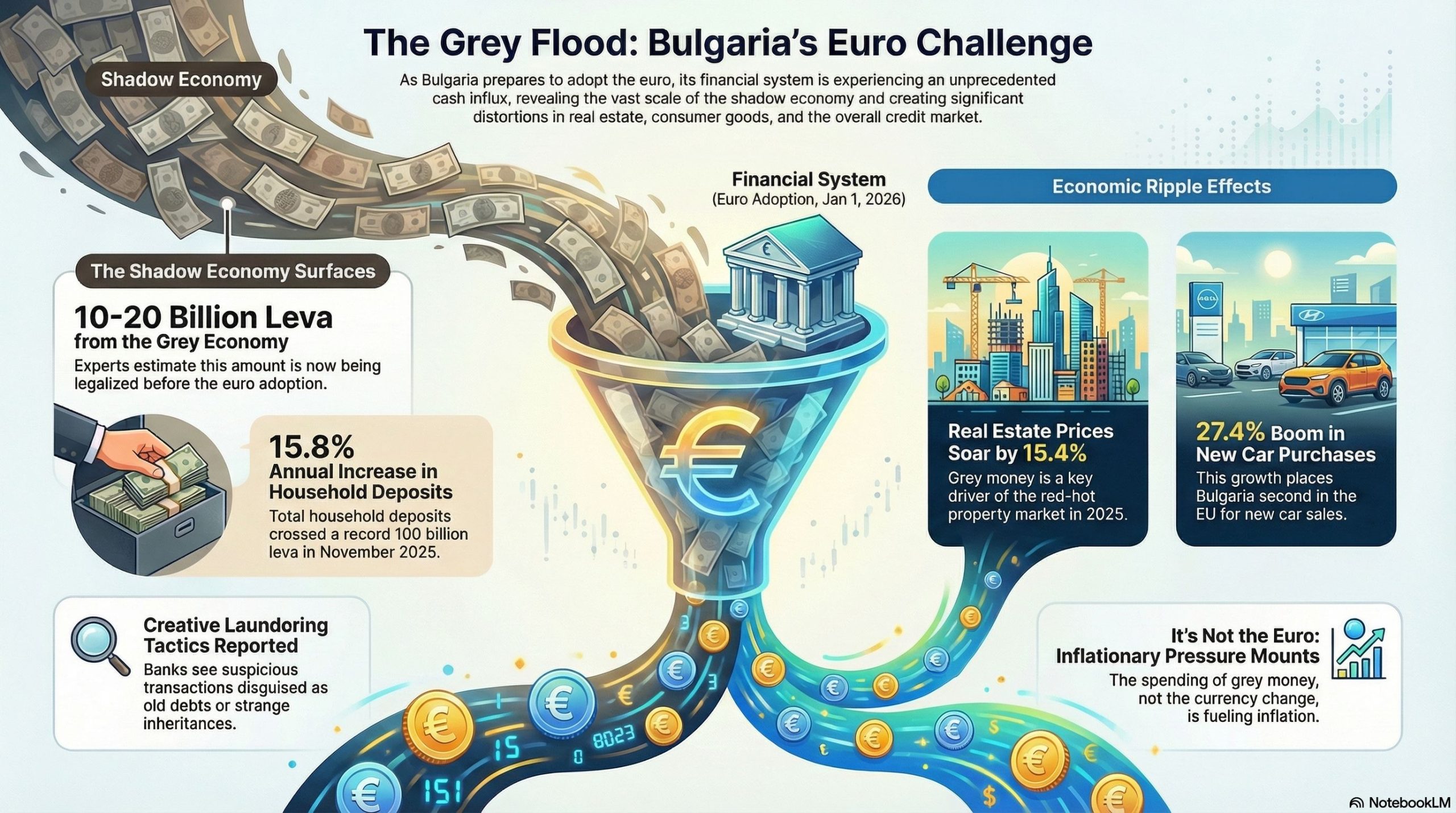
Household deposits (including non-profit organizations) crossed the historic threshold of 100 billion leva at the end of November 2025, reaching 100.88 billion leva. This represents 45.9% of the country’s projected gross domestic product. Compared to the previous month, banks absorbed approximately 2.9 billion leva in new deposits, while annual growth amounts to an impressive roughly 13.7 billion leva, or a 15.8% increase compared to November 2024, when deposits stood at 87.105 billion leva.
Non-financial business deposits amount to 48.619 billion leva (22.1% of GDP) at the end of November 2025, increasing year-on-year by 8.9%. Financial enterprise deposits grew by 19.6% year-on-year in November 2025 and reached 4.592 billion leva (2.1% of GDP) at the end of the month.
Total non-government sector deposits reached 154.09 billion leva, equivalent to 70.2% of projected GDP, with annual growth of 13.6%. The Bulgarian National Bank forecasts accelerated growth to 15.7% by the end of 2025, mainly as a result of expected intensive depositing before Bulgaria’s accession to the Eurozone.
Some commercial banks announced the elimination of banking fees for a certain period of time in 2025 when depositing leva to an account at the cashier or via ATM, with these funds to be automatically converted to euros after accession to the Eurozone.
The Grey Economy Comes to Light
Behind the impressive statistics, however, lies an uncomfortable truth. When planning the quantities of euros needed to replace leva, the BNB and banks have calculated that of the 30 billion leva in circulation, at least 10 billion leva are grey. The lack of official statistics on the share of this money gives rise to even more disturbing estimates—some analyses suggest the sum could reach 20 billion leva.
Financiers in the sector point to an increased influx of money from suspicious transactions and strange inheritances. By law, anyone depositing more than 10,000 leva in cash fills out a declaration of the origin of the money. Banking folklore is already replete with creative explanations: returned loans given 50 years ago, payments under contracts delayed by 20 years, advances against future contracts not yet signed, to money found in grandparents’ house just before its sale.
The incident in Gorna Oryahovitsa illustrates the absurdity of the situation—nearly 30,000 leva self-ignited and burned in a bank branch after an elderly man deposited 4,000 leva sprinkled with naphthalene against moths. During processing, naphthalene particles entered the climate control system and from the heat the money in the vault caught fire.
Real Estate, Cars and Inflationary Pressure
Grey money seeks legitimacy not only through the banking system. The real estate market is red-hot—property prices increased by an average of 15.4% in 2025, and in major cities the jump reaches 20%. A significant part of the price increase is due to grey money being legalized through real estate transactions.
There is also a boom in new car purchases, which increased by a full 27.4%, placing Bulgaria second in the EU on this indicator after Lithuania. Some of the transactions, especially for luxury vehicles, are likely financed by the grey sector.
The problem with this money is that it fuels inflation because it is spent intensively before the introduction of the euro. Year-on-year price increases have remained above 5% for several months now. The more money enters banks, the more the pressure on inflation weakens—this is the reason banks removed fees for depositing leva and are offering promotional offers for savings.
The Credit Boom and BNB’s Warnings
Alongside deposit growth, lending also remains high. The total amount of loans is already over 120 billion leva, with the end of November showing just over 2 billion leva more compared to October—respectively 117.6 billion leva in October versus 115.7 billion leva the month before. Household credit accounts alone already hold 55.4 billion leva. Of the 100 billion leva in household deposits, 55 billion leva have returned to them as loans.
Just over half of these loans are mortgage loans—32.1 billion leva, which have increased by nearly a third over the past year. Consumer loans amount to 21.356 billion leva, with annual growth of 13.6%. Just over half a billion—536 million leva—are other loans. Their volume is always smaller because interest rates on them are higher.
The BNB warned that the loan boom brings positives for bank profitability in the short term, but creates risk for their balance sheet in the long term. As reasons for loan growth, central bankers cite relatively favorable macroeconomic conditions and continued wage growth.
Central bank experts warn that the geopolitical situation remains very uncertain, and any deterioration in conditions will affect supply chains, goods exports, consumption and investment activity. Since the Bulgarian economy is highly integrated into international chains, any shock will affect borrowers’ solvency and lead to an increase in non-performing loans.
This is the reason the BNB Management Board kept the countercyclical capital buffer level at 2% for the first quarter of 2027 as well. The main task of this buffer is to serve as protection for the banking system against potential losses.
The Price Question: The Euro Is Not to Blame
Prices of fruits, vegetables, basic goods, some services and medicines are rising, but the reasons are not the introduction of the euro. For tomatoes and cucumbers, the price increase is over 17%, for cabbage and peppers—over 6-7%, for bananas and grapes—2-3%, for mature beans, lentils and eggs—3-4%. On the other hand, oil, cheese, fresh milk, flour and rice moved toward lower levels.
The most recent example is Croatia, which joined the Eurozone on January 1, 2023. There, the jump in prices for mass-market goods raised inflation by 0.3-0.4 percentage points. The European Central Bank, citing data from retail chains in Croatia, found that two-thirds of product prices showed no change, 25% registered a decrease, and 10%—an increase.
In the services sector—at restaurants, beauty salons, hairdressers and medical services—a noticeable increase is observed. The explanation is that these sectors lack serious external competition and when they are markedly local in character, these businesses take advantage of freer pricing mechanisms, not hesitating to round up the future exchange rate.
The European Central Bank’s official analysis of Croatia is categorical that the effect of the euro on prices two years later is minimal. The European Central Bank concluded that if the currency is changed and at that moment there are no additional macroeconomic shocks, then the “euro” effect will be one-time and moderate. Statistics show that the effect of its introduction is most often a one-time price increase in the range of 0.2 to 0.5 percentage points of inflation during the transition period.
The Global Context
In 2025, the world finds itself in the so-called new normal—a permanent turbulent situation. Global inflation is rising against the backdrop of raging military conflicts, more and more funds are being allocated for rearmament, energy prices are rising, which is reflected in higher transportation costs.
The European Central Bank notes: “In periods of global shocks (energy, raw materials, crises, instability), countries with high dependence on imports and energy resources significantly raise prices. This applies not only to Eurozone members, but also to those preparing to join.” Therefore, these macroeconomic factors should in no way be attributed to the euro.
Lessons from Other Countries
The historical overview of countries that adopted the euro reveals different scenarios. In Slovakia before 2009, the country gradually aligned its economy with that of the Eurozone, recorded growth, investments and living standards began to rise, but along with increased demand, prices imperceptibly became Western European, especially in the services sector and real estate.
In Estonia, the period before the Eurozone in 2011 was accompanied by growing confidence, which generated vigorous economic growth, high employment, tremendous wage and credit growth, a boom in housing investments, and all of this ended with a real estate bubble. The result was rising prices that caught up with European levels, after which the situation stabilized.
The situation repeated in Latvia in 2014 and in Lithuania in 2015. In anticipation of the euro, labor costs increased, loans peaked, massive investments and capital poured into construction, which inevitably led to increased demand and growth in income and expenses.
In most countries, the increased confidence accompanying entry into the Eurozone leads to a boom in loans and investments, and this acts as a powerful accelerator for consumption, demand, including for real estate. In countries with small markets, insufficient competition, poorly regulated services and sectors, the increase in demand is easily transferred to prices.
Conclusions
Bulgaria is entering the Eurozone at a moment of global economic turbulence, with record deposits but also with worrying signals about the quality of money in the system. No matter how technically prepared banks and the BNB are for the exchange, the real test will be how the economy will absorb the sudden influx of legalized funds and how it will cope with the subsequent pressure on prices and the credit market.
One third of household deposits are already in euros, while the rest await January for conversion. Queues at banks are expected to continue during the first month of the new year. The financial system is prepared, there will be no shortage of euros, but the real question remains: what will happen to those 10 to 20 billion leva in grey money now seeking a path to legitimacy?
The answer will become clear in the months after January 1, 2026, when Bulgaria officially becomes part of the Eurozone—with all its challenges, opportunities and risks.