


Twenty-four years ago, the EU came to terms with the existence of the Beneš decrees (the post-second world war decrees based on the principle of collective guilt), but an amendment to the Slovak criminal code could cast the issue in a new light.
After a change to Slovakia’s criminal code the issue of the Beneš decrees resurfaced in Slovakia at the end of 2025, one of the questions most frequently raised was how legislation based on the principle of collective guilt can still be in force in a member state of the European Union. (The Beneš decrees were a series of post-second world war Czechoslovak presidential decrees that, on the basis of collective guilt, stripped mainly ethnic Germans and Hungarians of their citizenship, property and rights.)
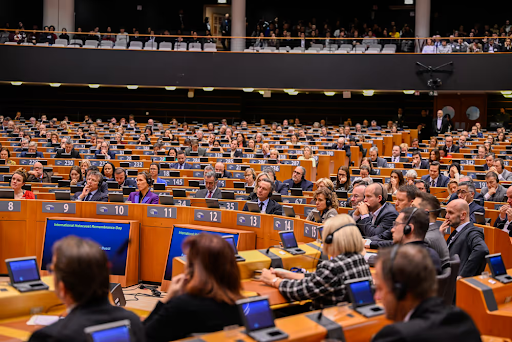
Representatives of the Hungarian opposition Tisza party protested in the European Parliament against the amendment of the Slovak criminal code which criminalises questioning or denying the Beneš decrees. Gabriella Gerzsenyi, an MEP for Tisza, had already asked the European Parliament in mid-December to investigate the matter, arguing that it runs counter to European rule-of-law principles that the decrees are still applied today (in practice, referred to in property-law disputes), and that criticism of the decrees is punishable.
Tisza succeeded in bringing the issue before the European parliament’s Committee on Civil Liberties, Justice and Home Affairs (LIBE). Jeroen Lenaers, a Dutch MEP from the European People’s party (EPP), also spoke on the matter, stressing that the decrees still provide a basis for breaches of the rule of law.
Meanwhile, Katalin Szili, former parliamentary speaker, an adviser to the Hungarian prime minister, Viktor Orbán, has also written to the European Commission, asking it to examine the new Slovak law. The European Commission has already indicated that it is dealing with the issue.
This is not the first time the matter has reached EU institutions, but so far no one has managed to get a grip on the decrees. The most important episode took place in 2002, when the question was whether the decrees which stripped mainly ethnic Germans and Hungarians of property and citizenship, could prevent the accession of the Czech Republic and Slovakia to the EU. It was then that the report was produced which has defined the EU’s approach to the decrees for almost a quarter of a century.
In this article, we examine how the retention of the decrees within the legal order can be reconciled with EU law, and whether the situation could change in light of the new developments in Slovakia.
What is the landmark 2002 Frowein report?
The Beneš decrees faced their greatest test in Europe in 2002. Before the Czech Republic and Slovakia joined the EU, the question seriously arose as to whether the fact that these countries continued to keep the decrees within their legal systems could constitute an obstacle to accession. Viktor Orbán himself raised this issue at the time, towards the end of his first term as prime minister, during the 2002 Hungarian election campaign.
The EU’s solution was to ask a three-member expert panel to prepare a report on whether the decrees were compatible with EU law and whether they could pose a problem during accession negotiations.
The European Parliament commissioned a German, a Swedish and a British expert to draw up the report. The backbone of the document was a study by Jochen Frowein, a professor at the Max Planck Institute. This was supplemented by comments from Ulf Bernitz, a professor at Stockholm University, and Lord Kingsland, a British lawyer and member of the Conservative party, who at the time served as the UK’s “shadow justice secretary”.
Frowein’s report concluded that the EU’s founding treaties could not be applied to legislation adopted in 1945–46, as they have no retroactive effect. As a result, the confiscations that took place after the war cannot be challenged under EU law. The report refers to a ruling by the Czech constitutional court, which established that the confiscations ended in the 1940s, and that the relevant decrees therefore ceased to serve as a source of law.
The report refers in several places to the 1997 Czech-German declaration, a rare political acknowledgement of injustice, in which the Czech side expressed regret that the decrees had led to the persecution of innocent people.
The report’s concluding finding was that the Beneš decrees could not constitute an obstacle to the Czech Republic’s accession to the EU. The authors emphasised that the report primarily concerned the Czech Republic, but that its conclusions were essentially also applicable to Slovakia. It is not insignificant, however, that Slovakia has never made any declaration regarding the Hungarian minority in Slovakia, comparable to that made by the Czechs towards the Germans – in other words, it has never acknowledged that the implementation of the decrees involved injustices.
The report also briefly analyses a 2001 ruling of the the Council of Europe’s human rights court (Prince Hans-Adam II of Liechtenstein v Germany), in which the Strasbourg court held that the confiscations of 1945–46 could not be examined under the European convention on human rights either, as that too has no retroactive effect.
Not relevant because they no longer have an effect
The report also addresses the circumstances under which Czech citizens whose property was confiscated under the Beneš decrees were able to reclaim it. This was regulated by a law that had, and still has, no equivalent in Slovakia – there, restitution legislation applied only to property taken after 1948.
The report also deals with the decree stripping Germans and Hungarians of their citizenship (here too it finds no problem in terms of accession, as the EU has no competence in matters of citizenship), as well as the decrees regulating the punishment of collaborators with the occupying powers.
In the latter case, the report stresses that if judgments handed down in the 1940s were still enforceable after EU accession, this could be contrary to EU law, and that this possibility would therefore need to be examined. It is precisely this finding that may now be of interest, given that it has emerged that decrees on land confiscation are still being enforced and cited in Slovakia today.
According to the British author of the report, the decrees underpinning the confiscations could not influence EU accession because “they currently have no effect on rights”. The decrees were therefore not relevant to accession, he argued, because they could not create new legal relationships.
This assessment may be cast in a somewhat new light by the fact that it has emerged that the decrees are still actively cited in property disputes in Slovakia.
What makes the situation new?
Napunk, a Slovak-Hungarian news outlet spoke to an EU law expert who requested anonymity about how the European Union could currently intervene in the debate over the Beneš decrees.
A new provision in the criminal code, which threatens six months’ imprisonment for those who deny or question the Beneš decrees, could lead to a situation in which, in an expropriation or property dispute, it is no longer possible to argue whether the legal basis for the expropriation is justified. That legal basis lies in the Beneš decrees, which have thus become immune from challenge. It is the combination of the two legal instruments that therefore constitutes the problem.
If, in such a case, I cannot challenge the violation of my property rights because the law on which the dispute is based cannot be challenged, then the right to legal remedy may be infringed.
When signing the law, Slovak President Peter Pellegrini said it was important that those litigating over their property should be able to do so without hindrance in the future as well. The question is whether such a statement by the president is sufficient for law enforcement authorities to see it the same way.
How can the EU intervene?
Can the European Union therefore tell Slovakia to amend the criminal code?
Unlike the Strasbourg court, EU fundamental rights protection applies only when EU law is engaged. The EU can only come into play if a cross-border or EU-law element arises in the case. The provision in the criminal code is a purely Slovak domestic matter, and EU law as such cannot intervene. This is not because the European Commission would not want to, but because the element required from the perspective of EU legal protection is missing. But if, for example, the property of a dual citizen were expropriated on the basis of the Beneš decrees, an EU element would already be present, and the EU’s institutions would have an interest in the matter.
The scope of EU fundamental rights protection is much narrower than that of the Strasbourg human rights court. The disadvantage of the latter is that it can take a very long time for a case to reach the hearing stage.
The advantage of EU fundamental rights protection is that it can also be invoked before a Slovak court. If an EU-law connection can be introduced into the legal dispute, then EU legal protection becomes available. In that case, it would be for the Slovak courts to decide on these issues. If they are unable to do so, a request for a preliminary ruling can be made to the court of justice of the European Union, which would treat the matter as a fundamental rights issue. It would not annul the Beneš decrees, because the court of justice cannot invalidate national law, but it could declare that a Slovak legal provision is contrary to EU law or to the EU’s Charter of Fundamental Rights.
Can infringement proceedings be launched?
It is within the European Commission’s discretion to decide when and how to initiate infringement proceedings against a member state.
Most infringement proceedings are technical in nature and largely do not make it into the press. They have two stages: the Commission stage, which receives little media attention, and the court stage, which usually does.
Over the past decade, in connection with Poland and Hungary, we have become accustomed to infringement proceedings as markers of major political, tectonic shifts, for example in relation to the independence of the judiciary.
According to the expert, this is not in fact what these proceedings are used for. From the perspective of individuals, it is largely irrelevant whether infringement proceedings are under way, because they do not provide real legal protection in the short term and are more of a political category. There have been few cases in which the court has issued interim measures ordering the suspension of the application of a national law. The basis of infringement proceedings is that a member state’s measure breaches EU law. If, therefore, we cannot articulate which element of EU law is infringed by the issue of the Beneš decrees, infringement proceedings cannot be launched.
Balázs Tárnok, a lawyer and vice-president of the European minority rights organisation FUEN, said at a conference held by the Hungarian Alliance party on Friday that there are ongoing court cases which could even justify infringement proceedings. Loránt Vincze, an MEP for the Democratic Alliance of Hungarians in Romania (RMDSZ party) and president of FUEN, said at the same event that even if infringement proceedings are uncertain, the issue of the decrees could also be examined under the EU’s rule-of-law mechanism. This, however, would require a decision by the European Commission.