


A spokesperson for the European Commission emphasized that countries must choose some form of solidarity, which Slovakia has failed to do. The Commission has already assessed Slovakia’s request for a deduction from the migration pact, but its decision is not public.
Slovakia is entering into another conflict with the European Union. This time, it concerns the issue of migration, as it has made no pledge of solidarity with other member states.
The new migration pact allows countries to choose between relocation, financial support, or material assistance. However, Slovakia and Hungary did not promise any form of assistance a key stage, which likely constitutes a breach of EU law.
Slovakia and Hungary made “no pledge”
The words “no pledge” appear next to Slovakia and Hungary in the EU Council’s implementing decision from December 18th. It is now up to the European Commission to say whether this is a violation of the migration pact.
“The solidarity mechanism is mandatory one,” said a European Commission spokesperson at a press briefing on Friday, January 9, while responding to a journalist’s question about the lack of commitment from the two countries.
The spokesperson pointed out that solidarity is flexible in terms of the type of contribution, but added that “all Member States must contribute in one way or another.”
The Commission has not yet ruled on whether this constitutes a violation of European rules. The spokesperson pointed to the fact that the member states had only recently adopted the decision. The Commission therefore did not have enough time to conduct the legal analysis necessary to declare a violation of European law.
“This decision was taken before the Christmas break, just before, and we’re now at the beginning of the year, so this is what I can say at this stage,” said the Commission spokesperson, adding that “we continuously monitor this, and we of course have the tools available if needed to make sure that Member States comply with EU law.”
Slovakia’s Ministry of the Interior did not respond to EURACTIV Slovakia’s question.
Another infringement threat
The main tool used by the Commission in cases where a state violates European law is the infringement procedure. It begins with an exchange of letters between the European institution and the Slovak government, but can result in a heavy fine from the Court of Justice of the EU. Slovakia is already facing infringement proceedings in case of recent constitutional amendment, which undermines the primacy of EU law.
Given that the Commission has not yet had time to assess the implications of Slovakia and Hungary’s decision not to promise any type of solidarity, EURACTIV Slovakia contacted Dr. Salvatore F. Nicolosi, a professor of migration law at the University of Utrecht.
“I think that there is a sufficient legal basis to claim that the position of Hungary and Slovakia is to be seen as a violation of the rules established in the Pact,” Nicolosi said.
He refers to Article 13 of the binding Regulation on the management of asylum and migration from 2024. IT states that Member States “shall pledge their solidarity contributions to the creation of an annual reserve.”
However, Slovakia and Hungary made “no pledge” in the key document.
Nicolosi adds that Slovakia or Hungary could have argued that while the regulation requires them to pledge a solidarity contribution, it does not require them to pledge a minimum However, according to him, such an argument could undermine the entire model of solidarity pool.
“Another important point to mention, in my view, is that by ratifying the treaty of Lisbon, the Member States accepted that, according to Article 80 TFEU, the implementation of the asylum policy will be based on compliance with the principle of solidarity and fair sharing of responsibility,” says Nicolosi.
According to him, the actions of Hungary and Slovakia violate European law. However, it is up to the European Commission to assess the situation in the same way and decide whether to take action.
“As we have seen in previous decisions on relocation, it is questionable to what extent infringement proceedings can be effective, assuming that the Commission decides to take this course of action, which is rather premature at this stage,” says Nicolosi.
Slovakia’s fair share
The EU Council document also included, for the first time, information on how much solidarity member states should show this year. The calculation is based on an analysis by the European Commission, which took into account the needs of coastal countries such as Spain and Italy, but also the size of Slovakia and its migration situation, including the number of refugees from Ukraine.
According to this analysis, Slovakia’s “fair share” of migration solidarity was 0.9856%. If Slovakia decided to help with relocation, it would be one percent of 21,000. It would therefore have to relocate approximately 207 migrants to its territory.
If Slovakia decided to help financially instead, it would be a percentage of €420 million. It would therefore have to send just over €4 million to southern countries.
The highest fair fell on Germany, with more than 21 percent, and France, with 16 percent. Both countries decided to relocate people, with Germany pledging to accept 4,500 migrants and France 3,300. However, most countries opted for financial assistance instead. The Netherlands will pay the most, almost €22 million.
State of Slovak deduction
The above table is missing a large chunk of EU countries. The first of which are the countries on the forefront of migration flows, who are in need of solidarity. A second group is countries like the Czech Republic and Poland, who have been granted a deduction from the solidarity pool. The argument goes that they faced an extraordinary migration situation in recent years by, for example, taking in large numbers of people from Ukraine.
Slovakia was not happy to be excluded from the list of countries with such leeway. At the end of November, it therefore asked the European Commission to review its decision. The Commission was supposed to assess the request within four weeks, and it did so.
“The Commission received a request for relief from Slovakia, assessed it, and sent the relevant information to the Council on December 23. The Commission’s assessment is not publicly available,” said a spokeswoman for the European Commission.
In a statement on December 31, the Ministry of the Interior claimed that it did not receive a response from the European Commission. Even if the Commission evaluates the request positively, the member states in the EU Council will still have to vote on a partial or full exemption from mandatory solidarity.
A source from the EU Council confirmed to EURACTIV Slovakia that member states would only decide on a possible exemption for Slovakia after the law comes into force, i.e. after June 12 this year.
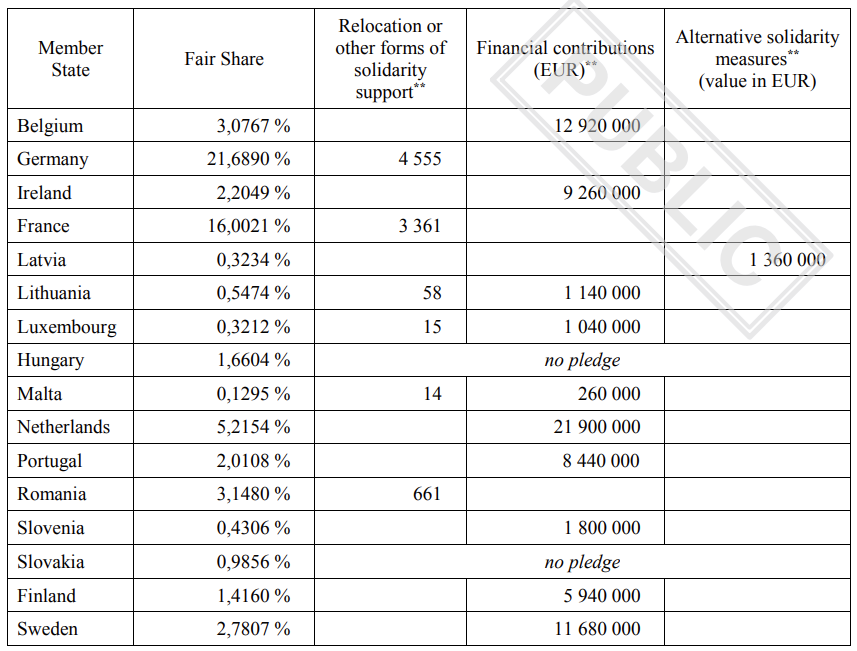
Source: Council of the European Union
Spain dissatisfied
Due to the number of exemptions granted and the “no pledge” made by Slovakia and Hungary, this year’s solidarity pool is significantly reduced. The European Commission originally proposed higher reference figures, meaning fair shares would be calculated from 30,000 relocations or €600 million. The member states, however, reduced this amount to 21,000 relocations or €420 million. Several countries then either received and deduction or refused to help.
These exemptions and refusals were subsequently not compensated, meaning that less than 60% of the overall fair share was pledged, from an additionally reduced reference number.
This is not an outcome the frontline countries were hoping for. Spain voiced disillusionment during the vote on the solidarity pool and ultimately decided to abstain.
“Spain is concerned that this Decision sets a negative precedent, not only for the solidarity pillar, but also for the Migration and Asylum Pact as a whole and for the balance between responsibility and solidarity, with just six months remaining before all its provisions take full effect.,” the country wrote in a statement.
The Migration Pact anticipated this possibility. If the solidarity pool is ultimately insufficient to cover the needs of frontline states, a simple majority of member states may request a reconvening of the EU Council to make up the shortfall.
In such a case, a “responsibility-sharing” scenario may also into play. In this scenario, Slovakia could, for example, be made in charge of the asylum process for migrants from Spain, but they would not be physically relocated to our territory. However, with 2026 being the solidarity pool’s inaugural year, the exact mechanism remains unclear.