


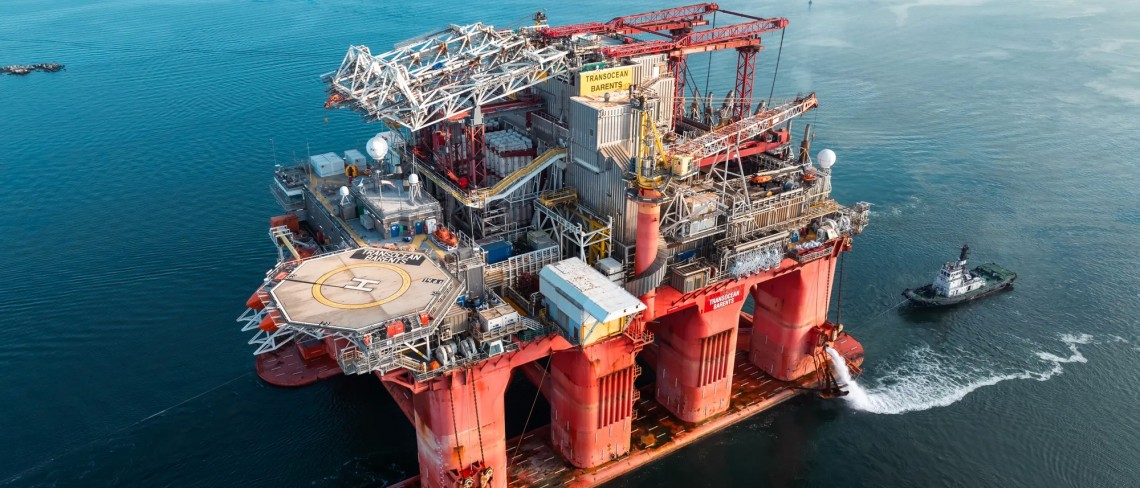
Romania’s Chief of Defense Staff, General Vlad Gheorghiță, recently said that the Neptun Deep area in the Black Sea is not covered by NATO’s Article 5.
Starting from the provision of Article 5 of the NATO Treaty, which states that “an attack against one member state shall be considered an attack against all,” the general explained the legal and security situation of the Neptun Deep zone.
“The Exclusive Economic Zone (EEZ) is not covered by NATO’s Article 5. There is a risk of interference in our area. (…) Our concern is to develop the necessary capabilities to defend critical infrastructure. We are not only talking about Neptun Deep, but also about submarine power and communications cables,” Vlad Gheorghiță said.
Romania’s Exclusive Economic Zone is a maritime area in the Black Sea where the country holds special economic rights, without exercising full sovereignty. The zone extends up to 200 nautical miles from the coastline (where geography permits) and is regulated under the United Nations Convention on the Law of the Sea (UNCLOS).
Romania’s rights in this zone include the exploitation of oil and gas resources, fishing, energy production, the installation and operation of platforms, pipelines and cables, as well as marine scientific research.
In practical terms, the EEZ is not sovereign national territory, nor is it territorial waters. Foreign ships and aircraft enjoy freedom of navigation and overflight.
This maritime area covers approximately 25,000 square kilometers (nearly 10% of Romania’s total territory) and is delimited by agreements with neighboring states.
Energy Minister: Extraction platform is covered by Article 5
Romania’s Energy Minister, Bogdan Ivan, said the offshore gas extraction platform at the Neptun Deep site is covered by NATO’s Article 5.
“At this moment, what is very clear is the following: the platform itself, through which the gas is extracted, is covered by Article 5. By contrast, all critical infrastructure — including pipelines — is not covered by this article. However, it is protected by the Coast Guard, the Ministry of Internal Affairs and the Ministry of Defense, in a framework focused on prevention,” Ivan told broadcaster Digi24.
The minister added that advanced systems are in place to protect critical infrastructure in the Black Sea, though some details cannot be made public.
“There are certain data I cannot disclose regarding the technologies used to protect critical infrastructure in the Black Sea, and these are among the most sophisticated systems. But it is obvious that, given such a vast area, it is impossible to monitor every vessel that passes through,” he said.
In this context, Ivan acknowledged the existence of a security risk, given the conflict at Romania’s border, but assured that authorities remain on schedule with the Neptun Deep project.
“We have this conflict at our border, and there is clearly an ongoing risk, but we are doing our job. We are on schedule with the exploitation of the Neptun Deep perimeter — in fact, we are ahead of the timeline set two years ago — and I am confident that at the beginning of next year, we will bring the first molecules of gas from the Black Sea continental shelf into Romania,” Ivan said.
The minister reiterated that, although risks exist, Romanian authorities are acting in a coordinated manner to prevent them, and that the extraction platform itself has the status of national territory.
“It is clear that this risk exists, but together with the Ministry of Internal Affairs and the Ministry of Defense, we are doing everything in our power to prevent it. And the platform itself, where the gas is extracted, is covered by Article 5, as it is considered Romanian state territory,” Ivan added.
Asked whether Romania could cope without NATO allied troop support in such a scenario, Ivan declined to go into military specifics.
“I do not want to enter a subject that is strictly military and intrude on the responsibilities of the defense minister. What I can say for sure is that we are fully synchronized with the Chief of Defense, the Interior Minister, and the Defense Minister on these scenarios, and each of these institutions is doing its job very well at this moment,” he said.
Defense Minister: Interior Ministry leads protection of critical infrastructure
Asked about the issue, Defense Minister Radu Miruță said that under current legislation, “critical infrastructure falls under the protection of the Ministry of Internal Affairs,” adding that he has never seen a case in which a NATO member suffered an attack without military intervention or allied support.
“The Ministry of Internal Affairs and the Ministry of Defense are not isolated structures that do not support each other in this country. Obviously, if such an issue were to arise, the Ministry of Defense would not stand idly by just because the law assigns primary responsibility to the Interior Ministry. These institutions, these units, these ministries all focus on protecting citizens, territory, and Romania’s economic interests. This is how the law stands today, and this is how things operate in Romania,” Miruță explained.
Asked whether, in the hypothetical case of a Russian attack on Neptun Deep, both ministries would intervene, Miruță replied:
“I would much rather see gas from Neptun Deep coming sooner, powering new thermal plants in Romania and increasing production. At the same time, there is legislation, there is the Ministry of Internal Affairs ensuring protection, and there is the Ministry of Defense, which can provide support whenever needed.”
Other cases where EEZs have been threatened or contested
Norway – North Sea
Norway’s offshore oil platforms in its EEZ became declared targets amid rising tensions with Russia. After 2022, Norway deployed military forces to guard offshore infrastructure, and NATO classified these assets as critical, despite their location in the EEZ.
Denmark – Sweden
The Nord Stream pipelines were located in Danish and Swedish EEZs. They were sabotaged in 2022 and, although Article 5 was not invoked, NATO recognized the incident as a major strategic threat.
Philippines – South China Sea
China has harassed Philippine vessels and platforms within the Philippines’ EEZ, and the Permanent Court of Arbitration in The Hague ruled that Beijing has no legal rights there. The EEZ has thus become a zone of hybrid conflict.
Israel – Eastern Mediterranean EEZ
Offshore gas fields threatened by Hezbollah prompted Israel to deploy naval forces and missile defense systems to protect its platforms, militarizing EEZ protection.