


The European Union’s decision to borrow €90 billion to cover Ukraine’s budget and military needs has raised concerns that Latvia’s national debt will also increase as a result of this commitment.
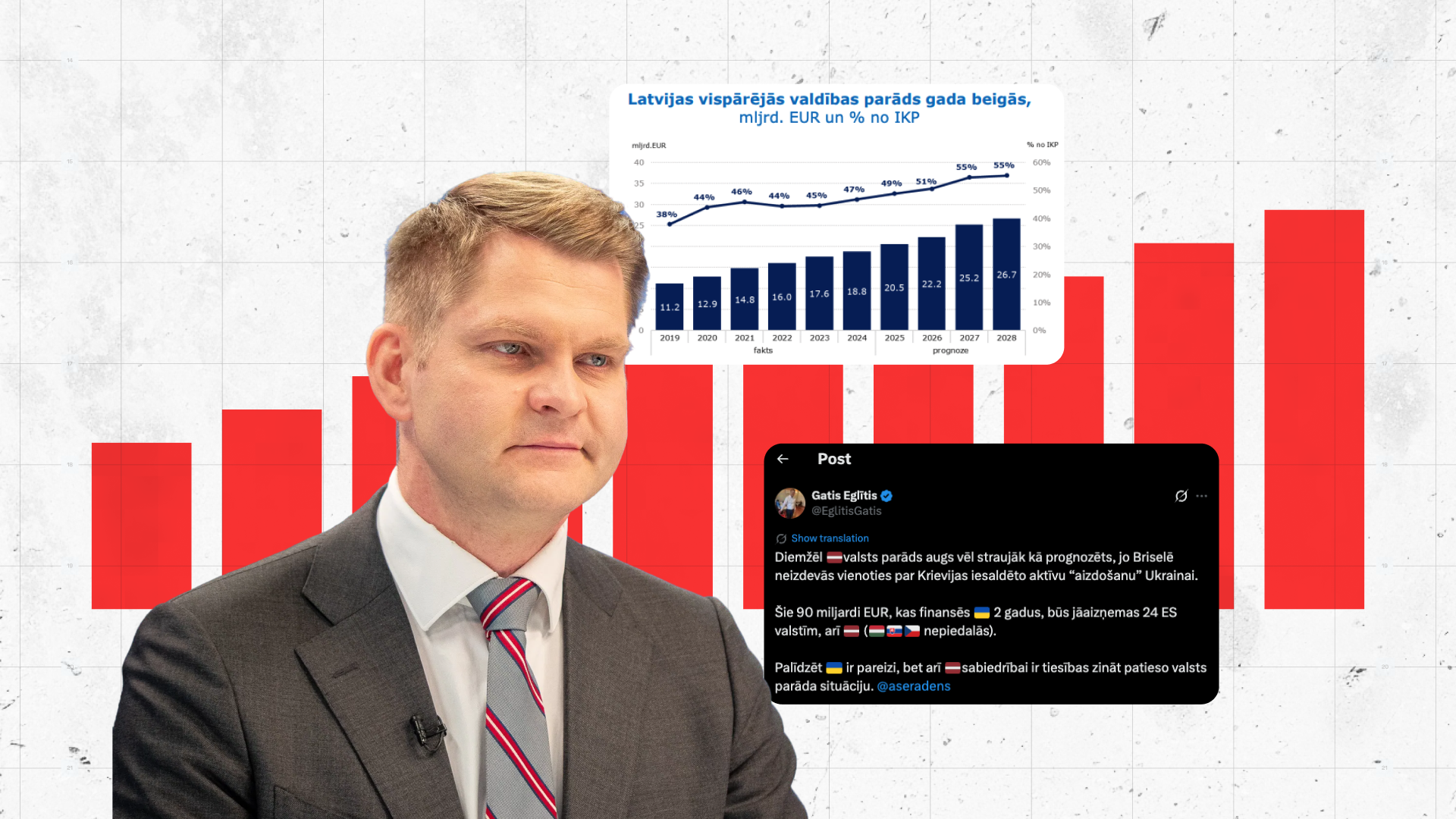
This is what economist and former Welfare Minister Gatis Eglītis claims on social media platform “X”, addressing the Minister of Finance and stating that “Latvian society has the right to know the true state of the national debt.”
However, the politician’s conclusion is not entirely correct – it is planned that the loan will be repaid using Russian reparations paid to Ukraine, which will not directly affect Latvia’s national debt. Although we are one of 24 member states that have agreed to take on interest payments and debt guarantees with this decision, it will still be the EU’s total debt, not the internal public debt of each member state, according to the Ministry of Finance and the European Commission.
Eglītis’s concern stems from the agreement reached by European Union (EU) leaders in Brussels in mid-December on financial support for Ukraine in the coming years – the EU will lend Ukraine €90 billion to compensate for Ukraine’s budget and military needs over the next two years.
Since the EU does not have such free money, it will borrow it on international financial markets. Kyiv would only have to repay this money when Russia pays reparations for the damage caused by its attack, while the EU will cover the interest expenses. Politico reports that the EU will pay three billion euros a year in interest on this loan to Ukraine. Three of the 27 member states – Hungary, Czechia and Slovakia – have refused to take on such commitments but have also agreed not to obstruct Ukraine’s financing plan.
As explained by Reuters, EU borrowing is covered by the EU budget reserve, which is the difference between the maximum amount that the EU can ask member states to contribute to the common budget and the amount needed to cover EU expenditure.
The Ministry of Finance emphasizes to the Delfi that the loan to Ukraine will be granted by the EU borrowing on financial markets, but this will not directly increase the public debt of member states, including Latvia.
EU-level debt, not national debt
Maija Celmiņa, advisor to European Commissioner Valdis Dombrovskis, also points out: “The debt incurred in this way will be EU debt and therefore will not be attributed to member states.” The obligations that this loan will create for member states will be theoretical, as it is expected that Ukraine will repay the €90 billion loan in the future from reparations paid by Russia.
Until that happens, the aggressor country’s assets in Europe will remain frozen, and the EU reserves the right to use them to repay the loan, in accordance with EU and international law, Celmiņa added. A specific plan for how this loan will be implemented is expected in the first days of January.
Celmiņa also pointed out that the same obligations would apply if EU leaders had been able to agree on a proposal to transfer frozen Russian assets to Ukraine now.
In an interview with Delfi, Eglītis said that the Ministry of Finance was spreading lies, as current decisions show that it is not possible to use Russian assets as collateral for the loan, and that each country will have to repay the interest on the loan jointly and severally. When asked whether Latvia should follow the example of Hungary, Czechia and Slovakia, he replied, “That’s not my call,” adding that “Ukraine should be supported, but we must not lie.”
Eglītis referred to an article in Euronews, which states that member states will share the payments proportionally to their economic weight. Germany, France, Italy, Spain, and Poland will bear the largest share of the costs. However, the article also emphasizes that, according to European Commission (EC) officials, the €90 billion will not be included in countries’ domestic debt levels.
Eglītis admitted in an interview with Delfi: “Latvia’s national debt is not increasing directly, because it is EC that is borrowing, but the commitments to our budget are increasing. Every year, the EC will send the 24 countries a bill for how much of the €90 billion loan interest payments each country has to cover. I don’t know what percentage of the annual €3 billion interest payment Latvia’s share is – for example, 5% would be around €150 million each year, which would be our ‘quota’ to pay.”
It has already been reported that the European Commission initially proposed a plan for long-term loans to Kyiv using EU-frozen Russian Central Bank assets worth approximately €210 billion, but this was opposed by Belgium, where most of the frozen assets are located. Belgium demanded guarantees for shared liabilities, which were unacceptable to other countries.
Even if EU leaders had managed to agree to transfer Russia’s frozen assets to support Ukraine, EU member states would have had to provide guarantees in proportion to their economic size in relation to the €210 billion financing package.
Earlier, the Latvian public media portal, citing Politico, reported that EU member states would have to set aside billions of euros for this purpose, but the largest contributions, amounting to tens of billions of euros, were offered by Germany (25%), France (16%), and Italy (12%). The Baltic states – Lithuania, Latvia, and Estonia – have pledged to contribute €934 million (0.4%), €469 million (0.2%), and €466 million (0.2%), respectively.
If, in proportion to the size of Latvia’s economy (0.2%), Latvia had to pay its share of the €3 billion in interest payments, it can be concluded that Eglītis’s example of 5% or €150 million is an exaggeration.
It is true that the increase in public debt and the growing costs of servicing it are a pressing issue in Latvia, as regularly pointed out by both economists and entrepreneurs. As previously pointed out by the Bank of Latvia, a significant increase in the amount of potential liabilities could worsen the sustainability of public debt.
Financial markets, seeing high risks, may refuse to lend or demand higher interest rates. As a result, the country’s debt servicing costs may increase, reducing funds for other budgetary needs. At the same time, the Fiscal Discipline Council (FDP) points out that Latvia is still among the countries with a relatively low level of general government debt – 48% of gross domestic product (GDP) – and meets the Maastricht criterion of keeping debt below 60% of GDP.
It should be noted that this is not the first time that the EU has provided financial support to Ukraine in this way – at the end of 2022, the European Parliament approved an €18 billion loan, while in 2023 a special support mechanism was established, allocating up to €50 billion in grants and loans to Ukraine from 2024 to 2027.
The EU has previously borrowed money not only to support Ukraine. For example, the financing of the EU Recovery Fund, which was introduced in 2021, is borrowed money.