

Following the ‘great replacement’ theory, both white supremacists and some Finns Party politicians have launched a debate in Finland on the return migration of immigrants. The idea originates from elsewhere in Europe and the United States, where the Trump administration is already deporting immigrants en masse.
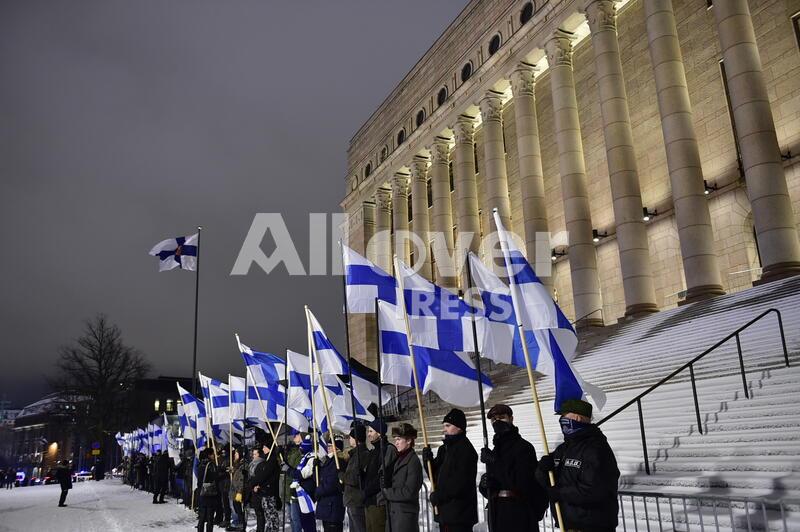
It is the evening of Independence Day, 6 December 2025, in Helsinki. The far-right Suomi Herää (Finland Awakens) demonstration has reached its destination in front of the Parliament House. The procession assembles members of the street patrol Soldiers of Odin, the fascist Sinimusta liike (SML) party and the far-right martial arts club Active Club. The demonstrators are united by their support for ethno-nationalism and white supremacy. Behind the speakers, a banner reads: “Return or extinction”. After the event, most of the protesters will join the 612 torchlight procession, which brings together both those who call themselves ‘nationalists’ and the far right.
“Remigration” is the new buzzword of the far right. It refers to the attempt to remove ethnic minorities and immigrants who have already arrived in the country. In Finland, members of the fascist Sinimusta movement have written about the topic on social media, as have anonymous accounts on Telegram discussion channels linked to the far right.
Tommi Kotonen from the University of Jyväskylä, who studies the far right, says that the term “remigration” has recently become more common among the Finnish far right. In May, members of the SML attended the Remigration Summit conference in Italy, which addressed this topic. The conference featured a speech by Martin Sellner, leader of the Austrian identitarian movement and the father of the term in its current form. According to Kotonen, the term was used more sporadically in Finland before the conference, although the idea may have been discussed using other words.
“At the same time, the idea has been spread more effectively internationally. The way people talk about it in Finland reflects the international change,” Kotonen says.
Sellner published a book on the idea of remigration a few years ago. According to Kotonen, Sellner wrote it in parallel with a work dealing with new strategies of the far right. The far right has adopted the idea of remigration as its strategic spearhead. The new focus has spread throughout Europe, not just among identitarians. In August, the pro-Russian far-right party Norway Democrats organised a conference on remigration, which was also attended by representatives of Germany’s AfD party. The Norway Democrats has vowed to “forcibly return all illegal and unlawful welfare immigrants to their home countries”, if necessary.
The Trump administration in the US has expressed strong support for remigration, a term used to describe the mass deportations carried out in the country. Billionaire Elon Musk has also promoted the same idea.
Shifting the boundaries of permissible speech
The discourse on remigration serves in spreading a radical view by using an apparently neutral term. Lauri Hokkanen of the Sinimusta movement described the use of the term in the far-right online magazine Kansalainen shortly before Independence Day as follows: “The taboo surrounding the term ‘population replacement’ is slowly beginning to be broken. The positive solution to this negative problem is return migration.”
In line with the concept launched by American political commentators in the 1990s, Hokkanen refers to the shifting of the ‘Overton window’ as the far right broadens the understanding of what kind of speech is appropriate in politics.
Hokkanen’s comment relates to how leading politicians from the Finns Party, a key partner of Finland’s right-wing coalition government, are already openly talking about population replacement. The term is widely associated with a far-right conspiracy theory that claims the European population is being replaced by Muslims and other unwanted immigrants. Politicians regularly deny that they are referring to this conspiracy theory but continue to use the term.
For example, in an August 2025 Facebook post, Finns Party MP Wille Rydman wrote that population replacement is not “a conspiracy, a theory, or a conspiracy theory”.
Rydman justified his claim by saying that many politicians talk about how people from abroad must be encouraged to move to Finland due to labour needs or solidarity, and that these people then have children in Finland.
“The end result is a Finland that is becoming less and less Finnish. A country that is rapidly being populated by people who are anything but Finnish. The term ‘population replacement’ aptly and accurately describes this phenomenon,” Rydman wrote.
According to Riikka Purra, chair of the Finns Party, “population replacement” leads to segregation, immigrant neighbourhoods, crime and polarisation. “This is a drive against the wall, this is bankruptcy, population replacement is the end of the welfare society, the end of Finnish society,” she said at the party’s summer meeting in August.
Researchers have interpreted this double message as an attempt by politicians to appeal to their far-right voters.
According to Jakob Guhl, director of policy, research and counterterrorism for the Institute for Strategic Dialogue, the power of the remigration discourse lies in its ambiguity. The term can be associated with radical and violent imagery, but it also serves the political debate of established parties.
Tommi Kotonen notes that Lauri Hokkanen’s statement reflects an attempt to shift the Overton window through the debate on return migration. However, his SML party cannot do this alone. “They can normalise the term on social media. This creates a situation where the term is not as widely condemned,” says Kotonen.
Differences of opinion in the debate on repatriation
The idea of return migration has already entered the speeches of Finns Party politicians. For example, in 2023, the party newspaper Suomen uutiset reported on the Finns Party’s efforts to encourage the voluntary return migration of immigrants.
Simo Grönroos, chairman of the Suomen Perusta think tank and current deputy chairman of the Finns Party, urged the Parliament’s Committee for the Future that same year to consider “how the return migration of poorly integrated immigrants could be promoted through cooperation between countries in order to reduce the problems caused by immigration and make it easier for poorly integrated immigrants to find their place in society in their old home countries”.
Jari Mäkäräinen of the Finns Party has been closer to the far right’s remigration rhetoric. In November 2025, Mäkäräinen wrote on messaging service X: “Somalis can leave Finland to build their national home in Somalia as well. Remigration now!”
Mäkäräinen previously served as special advisor for communications to Minister of Finance Riikka Purra. He left his post in the summer of 2025.
During the current government term, the Finns Party has sought to promote the faster return of asylum seekers. However, the term repatriation has not yet become as established in the party’s rhetoric as it has in Germany and Austria, for example. Reciprocally, the use of the term in connection with the removal of immigrants from the country has not yet attracted the same criticism in Finland as the term ‘population exchange’.
In other Nordic countries, too, some leading politicians are talking about return migration. For example, Morten Messerschmidt of the Danish People’s Party filed a criminal complaint against Martin Lidegaard of the Radical Left after Lidegaard criticised Messerschmidt for wanting to deport thousands of people on the basis of their skin colour. Messerschmidt himself did not mention skin colour, but according to Lidegaard, his demands were directed at certain ethnic groups. In Sweden, the government has made attempts to speed up the return migration of immigrants through financial support.
Origins in the policies of the centre-right
The idea of voluntarily returning immigrants is not new in European politics. Centre-right governments in France and Germany first proposed it in the 1970s and 1980s. During President Valéry Giscard d’Estaing’s term in 1977, France offered a 10,000-franc incentive to returnees, in line with a proposal of the Secretary of State Lionel Stoléru.
The background to this was the strong influx of North African labour after the Second World War, which France had used to build motorways, factories and power plants. However, the boom had ended with the oil crisis and rising unemployment.
Only a few immigrants who had built their lives in France took advantage of the return allowance offered by the government. The result was similar in Germany, where Chancellor Helmut Kohl promised in 1982 to repatriate one million immigrants by using financial incentives.
Although the results of the return migration policy were meagre, the idea remained alive, especially on the far right. The French National Front, which had been struggling on the political margins, made anti-immigration the focus of its campaign in 1977–1978.
The party systematically linked immigration to social problems, crime and unemployment. Its election slogan “two million unemployed is two million immigrants too many” finally brought the National Front a breakthrough in national politics in the early 1980s and provided a model for the European far right.
Common goal, different discussion?
Tommi Kotonen believes that before long, return migration will become a mainstream issue in Finland, just as population replacement was a few years ago.
“Population replacement was originally an anti-Semitic conspiracy theory. The term was softened when it began to be used to refer to a statistical fact. Sellner and others are doing the same kind of reframing with regard to remigration.”
Originally, remigration was linked to the idea of “reconquista”, or reconquest. Jari Mäkäräinen of the Finns Party has already written in X that he demands not only remigration but also reconquest.
“The idea is to stop the Muslim invasion by more or less violent means and turn it into remigration. Now it is being framed as a project that could be implemented within the current parliamentary system,” says Kotonen.
He has not yet noticed a shift in the mainstream discourse of the Finns Party towards remigration, but the situation may change. In that case, talk of return migration could serve in double messaging.
“As with population replacement, the party likes to use the same term and associate itself with even more radical ideas. If the term is brought into mainstream discourse, at least its most extreme interpretation is debatable,” Kotonen says.
In the case of population replacement, the discussion of the term is based on the definitions of the Finnish Security Intelligence Service (SUPO). However, SUPO treats population replacement as a motivator for terrorist violence and does not consider the mainstream political references to population replacement in the same way. The same dichotomy may be present in the debate on return migration.
In a comment sent to Faktabaari by email, SUPO states that the topic is also of interest to the Finnish far right. “Generally speaking, some members of the violent far right also have a positive attitude towards the theme of return migration, but mostly, it is a matter of non-violent influence. We cannot comment on the operational details,” SUPO commented.
Tommi Kotonen also cannot recall any situations where return migration has been used to justify extremist violence. “It is very likely that someone has used a similar term, but not to the same extent as population replacement,” Kotonen says.