


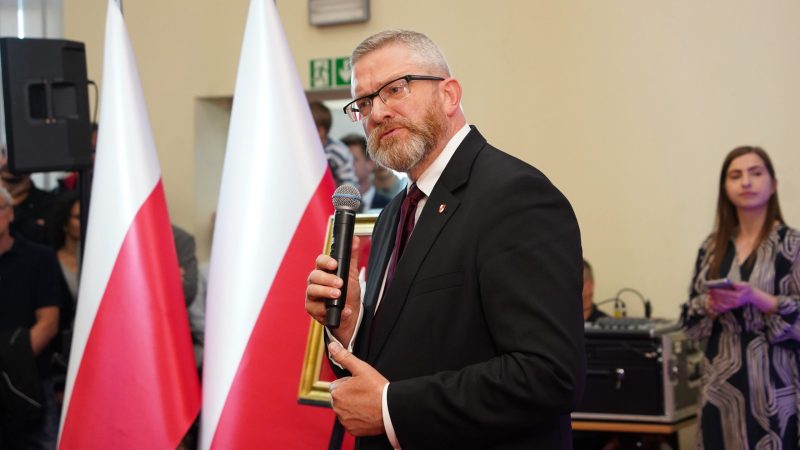
Grzegorz Braun, the leader of the far-right Confederation of the Polish Crown, has surprisingly emerged as the biggest winner in Polish politics for 2025—eclipsing even Karol Nawrocki, who unexpectedly won last year’s presidential elections.
This raises a crucial question: how can a politician with views further to the right than Germany’s AfD achieve such high popularity?
In a move half a year ahead of Poland’s presidential polls in late 2024, Grzegorz Braun, a prominent hardliner in Polish politics and a leading figure within the far-right Confederation Freedom and Independence party (Confederation), opted to pursue his own political agenda. He made an unauthorised bid for the presidency, refusing to back the grouping’s official, more moderate candidate, Sławomir Mentzen.
His expulsion from the Confederation, while an immediate consequence of this move, ultimately proved to be a masterstroke. Braun, despite having no genuine prospect of winning or even making the runoff, secured a victory commensurate with his aspirations: he finally escaped years in the political shadows to become a significant force on the Polish political scene—a remarkable accomplishment for a politician holding such extreme views.
In a recent IBRiS poll for the Wirtualna Polska news outlet, the grouping led by Grzegorz Braun, the Confederation of the Polish Crown (distinct from the larger umbrella Confederation party mentioned earlier), has achieved support exceeding 7 percent. This places it behind only Prime Minister Donald Tusk’s Civic Coalition (KO, EPP), Law and Justice (PiS, ECR), and the “big” Confederation. This is a notable rise, given that when Braun initially split from Confederation, his new party registered only 2 percent support.
Radical and Popular – What’s the Secret?
Grzegorz Braun’s December 2023 action of extinguishing a Hanukkah menorah with a fire extinguisher in the Polish Parliament drew international attention. This anti-Semitic incident caused a major scandal.
The outcry stemmed not only from Braun’s violation of a long-standing tradition of parliamentary Hanukkah observance in a country with centuries of significant Jewish presence, but also because the discharge of fire extinguisher powder injured a Jewish woman who attempted to stop him.
The incident, while costing Braun, then a Polish MP, his parliamentary immunity and a portion of his salary, paradoxically amplified his popularity rather than damaging his reputation. The leader of the Confederation of the Polish Crown adopted the fire extinguisher as a personal symbol, going so far as to refer to a “fire-extinguisher front,” which he used to describe those who aligned with his views.
A parody song about the event was created, based on the Polish adaptation of the Irish melody “Peggy Browne,” which was composed by Turlough O’Carolan, and sung in Polish by the Myslovitz band.
“Oh Grzegorz Braun, oh Grzegorz Braun, who could extinguish candles like this, oh Grzegorz Braun, oh Grzegorz Braun, Poland and the whole EU have seen it,” go the lyrics of the parody song.
Braun also drew large crowds at campaign events, with rallies last year attracting hundreds of attendees.
Despite his electoral success, he remains an extremely radical and highly polarising figure; even Germany’s AfD was hesitant to collaborate with him after he won a mandate in the 2024 European elections. While other Confederation members joined parliamentary groups—Ewa Zajączkowska-Hernik and Marcin Sypniewski in the new AfD-founded Europe of Sovereign Nations, and Anna Bryłka and Tomasz Buczek in Patriots for Europe—Braun remained unaffiliated.
In Brussels, he quickly became known as the most controversial Polish Member of the European Parliament since Janusz Korwin-Mikke (2014–2018), who infamously claimed women should earn less than men, justifying it by stating they are “smaller, weaker, and less intelligent.”
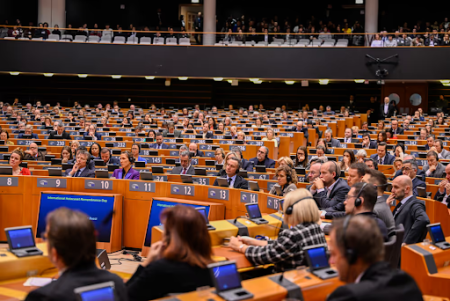
Following his disruption of a minute of silence dedicated to Holocaust victims, Parliament President Roberta Metsola had Braun’s parliamentary immunity lifted and barred him from European Parliament debates for a period of six months.
Controversial Figures Surrounding Braun
Concerns also extend to Grzegorz Braun’s allies. An example is Roman Fritz, an MP with the Confederation of the Polish Crown, who recently sparked controversy by defending Braun’s denial of the gas chambers’ existence at the Auschwitz-Birkenau Nazi concentration camps during an interview.
During an appearance on the Kanał Zero YouTube media platform, Fritz stated, “For my own research, I once tried to find information online about gas chambers at Auschwitz. There’s very little. You can even Google it yourself to see if there are pictures of the gas chambers.”
“There are only photos of two buildings, but any building could look like those online. So, practically, there is no evidence available online.”
Mateusz Piskorski, a former MP, is another particularly controversial ally of Braun. Braun has announced that Piskorski will be a key figure on his electoral lists for the 2027 parliamentary elections.
Despite facing an ongoing trial for espionage on behalf of Russia and China, and being legally prohibited from leaving the country, Piskorski maintains an active media presence, contributing to pro-Russian publications.
Braun’s declared objective is the “political reactivation” of Piskorski, which fundamentally means restoring the parliamentary mandate he previously held.
Braun Gains from the Weakness of Poland’s Main Right-Wing Party
According to Dr. Mirosław Oczkoś, a political image and marketing expert from the Warsaw School of Economics, the key to Braun’s political success lies in his persona as a victim of persecution within Polish politics.
“In Braun’s case, his expulsion from the “broader” Confederation is seen by some supporters as proof that he is being repressed, excluded, and marginalised,” Oczkoś told Euractiv Poland.
“At the same time, it also highlights that the “broader” Confederation, when Braun was still part of it, had a distinct hardline segment.”
Braun’s position is also strengthened—said Oczkoś—by the diminished public standing of PiS, Poland’s primary right-wing party, which was removed from power following the 2023 elections.
“For the most radical voters, PiS today appears to lack the energy it once had. They are therefore searching for messages that are clearer, more forceful, and more radical.”
“If someone declares that they do not identify with the centre, liberalism, or especially the left, PiS is simply not radical enough. They need a message with much greater intensity.”
Oczkoś noted that some right-wing voters, especially younger ones, identify as economic libertarians. Their support is fueled by an attraction to messages promoting low taxes, deregulation, and opposition to the EU, which they perceive as a constraint on individual freedom.
“They often ignore the ideological layer of these messages. But at its core, beyond calls for economic freedom, there is hardline radicalism.”
Oczkoś also attributed the increased far-right support, including for Braun, to the electorate of President Karol Nawrocki. Nawrocki, an officially independent but PiS-backed candidate in the 2025 presidential elections, facilitated this trend.
“Nawrocki is definitely ideologically closer to both Confederations than to PiS,” Oczkoś said.
“This overlaps with the ‘freshness’ effect of recent elections: voters who supported Nawrocki six months ago do not change their views overnight.”
The Right Expands, Donald Tusk Moves to the Right
Poland’s far-right is clearly expanding, currently encompassing three major parties to the ideological right of the ruling coalition: PiS, the Confederation, and Braun’s Confederation of the Polish Crown. Should these groups unite, they would secure a stable parliamentary majority.
While the Civic Coalition, the strongest party, has maintained its standing, smaller coalition parties are seeing a sharp decline in the polls, and the Civic Coalition itself is exhibiting a rightward shift.
The party remains a coalition of diverse members, encompassing liberals, conservatives, and individuals with varying religious stances, both Catholics like Donald Tusk and atheists. This diversity is reflected in the differing perspectives on controversial social topics, including abortion and LGBT+ rights.
Despite the celebratory tone in Brussels and certain European capitals over the removal of PiS, expecting a “pro-EU paradise,” the party’s messaging under Donald Tusk’s restored leadership is being reshaped. As the author of this article argued in a piece for Euractiv.com, Poland under the new government was unlikely to meet those high pro-EU expectations.
According to Oczkoś, the far-right’s influence on political discourse in Poland is a direct result of its increased visibility, especially through online platforms.
Right-wing politicians in Poland “generally understand social media better and make more effective use of algorithmic dynamics.”
Oczkoś suggested that the right’s political success in Poland stems from a perceived, rather than total, dominance over its rivals, noting that “the impression of dominance exists – and that impression works politically.”
This influence is wide-ranging, as he observed that many political actors and groups have internalised the lesson that a rightward shift yields tangible electoral gains.
“If we look at Polish presidents since 1989, the vast majority can be classified as right-wing politicians. The only clearly liberal-centrist president was Aleksander Kwaśniewski, who, contrary to popular belief, was not truly left-wing.”